
Automotive
What Are the Education Requirements for Mechanics?
Thinking about becoming an auto mechanic? Learn what education you’ll need, from high school preparation and trade school training to ASE certification.
In This Article
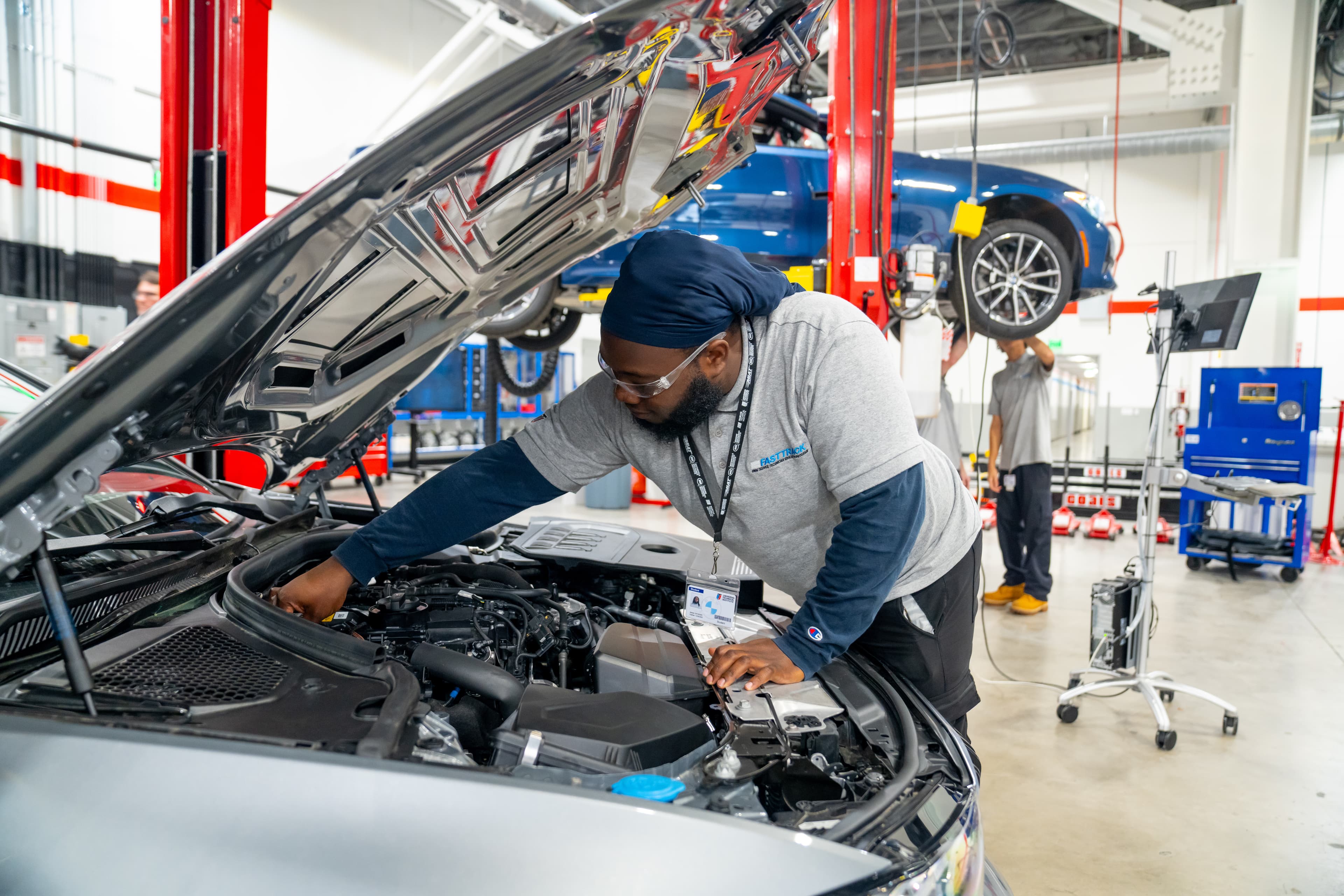
Cars have changed. Along with mechanical systems, today’s automotive technicians work with onboard computers, sensors, networks and high-voltage components.
That is why the education requirements for mechanics are less about collecting one academic credential and more about building a practical mix of foundational education, technical training and supervised shop experience.
You do not need a bachelor’s degree to become an auto mechanic. Many employers look for a high school diploma or equivalent, and a postsecondary non-degree credential is the typical entry-level education for automotive service technicians and mechanics.
Some people complete trade school first through a program like the Automotive & EV Technology program at Universal Technical Institute (UTI), while others start in an entry-level shop role and learn on the job.1 Certifications can come next, depending on the work you want to perform.
Here is how those pieces fit together and how to choose a route that makes sense for you.
Key Takeaways
- A high school diploma or equivalent is the most common starting point. It is also a typical admission requirement for an automotive trade school.
- A four-year degree is not required. Mechanics may train through a certificate, diploma or associate degree program; employer training; or a combination of school and work.
- UTI offers a structured training option. Its 51-week Automotive & EV Technology program combines instructor-led online learning with hands-on lab sessions.⁷
- Hands-on experience matters. Classroom knowledge becomes useful when you can inspect, test, repair and verify work on actual vehicles.
- Education and professional certification are different. A school credential documents completed training, while certifications such as National Institute for Automotive Excellence (ASE) may involve separate testing and experience requirements.
- Additional requirements depend on the work performed. Certain specialties, such as paid motor vehicle air-conditioning service, require specific certification.
What Education Is Required To Become an Auto Mechanic?
Most aspiring auto mechanics should plan to complete high school or an equivalent, then gain technical knowledge and hands-on training through a postsecondary program, an employer or both. A bachelor’s degree is not the standard entry route.
There is no single nationwide education rule for every automotive mechanic job. Employers set their own hiring standards, schools set admission requirements, and certain repair categories have separate certification or licensing rules. In practice, the education required for a mechanic usually has four parts:
Part of the education path | How it fits |
High school or equivalent | Builds basic math, reading, computer and problem-solving skills. It is a common hiring and trade school admission requirement. |
Postsecondary technical training | Provides structured instruction and lab practice in vehicle systems, diagnostics, tools and shop procedures. Programs may award a certificate, diploma or associate degree. |
On-the-job training | Develops speed, judgment and consistency under real shop conditions, usually with oversight from experienced technicians. |
Certifications or licenses | Show knowledge in a specialty or authorize certain work. What is needed depends on the employer, task and location. |
The right route depends on how you learn, how quickly you want structured exposure to multiple vehicle systems, and what kind of shop you hope to enter. The sections below explain the tradeoffs.
Read: Universal Technical Institute’s Admissions Requirements
Education Paths for Aspiring Auto Mechanics
There are several workable paths into automotive service. None eliminates the need to keep learning; they simply organize that learning differently.
Do mechanics need a high school diploma?
A high school diploma or recognized equivalent, such as a General Educational Development (GED) credential, is a common baseline for auto mechanic jobs and postsecondary automotive programs. Some employers may hire without one, but completing high school generally gives you more training and hiring options.
High school also supplies skills technicians use every day. Repair information is written and technical. Measurements need to be exact. Diagnostic work depends on logic, basic science and the ability to follow a process without skipping steps.
Helpful high school courses
If they are available, these courses can give you a useful head start:
- Automotive or shop classes for tool familiarity, safety and basic service tasks.
- Algebra and applied math for measurements, ratios and electrical calculations.
- Physics or physical science for force, motion, heat, pressure and electricity.
- Electronics or computer courses for circuits, sensors, software and data.
- English and communication for reading service information and documenting findings clearly.
You do not need every class on this list before you begin training. They are helpful preparation, not a substitute for automotive instruction and supervised practice.
Learning through trade school or a technical program
Automotive trade school gives beginners a planned sequence: Learn the concept, see the procedure and practice it in a lab. That structure can make it easier to connect engine performance, electrical testing, brakes, steering, suspension and other systems instead of learning only the jobs that happen to enter a shop that week.
Program length and award type vary. A focused certificate or diploma program may take less time than an associate degree, while a degree may include general education courses in addition to automotive training. Compare the curriculum, amount of lab time, instructor access, equipment and student support. Not just the name of the credential.
Trade school admission requirements also vary. Many schools ask for a high school diploma, GED or another accepted equivalent, plus proof that the applicant meets age and documentation standards. Review the school’s current requirements before applying.
Learning on the job
Some mechanics begin in roles such as lube technician, tire technician, shop helper or parts assistant, and add responsibility as they demonstrate safe, accurate work. A good employer may provide mentoring, task-specific training and access to service information.
This path can get you into a shop sooner, but it may take longer to build broad knowledge. What you learn depends on the vehicles, repairs and coaching available at that workplace. People who start on the job still benefit from studying electrical theory, diagnostics and vehicle systems outside the tasks immediately in front of them.
Read: What Actually Happens Inside an Auto Repair Shop
What Do You Learn in Automotive Trade School?
A solid automotive program should teach more than how to replace parts. The goal is to understand how vehicle systems work, use evidence to find a fault, perform the repair safely and confirm that the repair solved the problem.
Vehicle systems and repair fundamentals
Training commonly covers engines, fuel and ignition, cooling, powertrains, brakes, steering and suspension, transmissions, climate control, and preventive maintenance. Students may practice inspections, disassembly and reassembly, measurements, adjustments, and common service procedures.
The most useful labs connect theory to a repeatable process. Instead of memorizing one fix, students learn what normal operation looks like, which test can confirm or rule out a cause, and how one system can affect another.
Electrical systems, diagnostics and EV technology
Electrical knowledge is central to modern automotive work. A technician may need to read wiring diagrams, test voltage and resistance, interpret scan-tool data, and trace a problem across sensors, modules, wiring and connectors. A diagnostic trouble code points the investigation in a direction; it does not automatically identify the failed part.
Programs may also introduce hybrid and electric vehicle architecture, high-voltage safety, and the differences among internal-combustion, hybrid and battery-electric systems. The depth varies, so anyone interested in EV work should compare course descriptions closely.
Read: Preparing for EV-Specific Diagnostics: Skills and Tools
Tools, safety and shop procedures
Technical ability includes knowing when and how to use hand tools, power tools, lifts, meters, scan tools and service information. It also includes personal protective equipment, lift-point checks, torque procedures, battery and high-voltage precautions, fluid handling, and an organized work area.
Students should practice a complete service workflow:
- Clarify the concern and review available information.
- Inspect the vehicle and establish a safe test plan.
- Measure or test before deciding what failed.
- Complete the approved repair using the correct procedure.
- Verify the result and document the work.
That final verification step matters. A repair is not complete merely because a part has been installed.
Read: Essential Auto Mechanic Tools: Complete Tool List
Do Auto Mechanics Need Certifications or Licenses?
There is no single nationwide mechanic license required for every automotive repair job. Certification expectations depend on the employer and specialty, while federal, state or local rules may apply to particular work.
It helps to separate three terms. A school certificate or diploma shows that you completed a training program. Program accreditation evaluates the school or program against an outside standard. Professional certification evaluates an individual technician, usually through testing and sometimes work experience.
ASE certification and entry-level testing
The National Institute for Automotive Service Excellence (ASE) offers professional certifications across automotive specialties. To become ASE certified, a technician must pass the applicable test and satisfy the required hands-on work experience.
The experience requirement varies by test, and some formal training, such as UTI’s Automotive programs, can count toward part of it. ASE explains the current rules on its work experience page.
ASE also offers entry-level testing for students and people preparing to begin their careers. Those credentials do not require work experience and are not the same as professional ASE certification. Both can help document knowledge, but they represent different milestones.
When certification is required for certain work
Some tasks carry specific requirements. Under the U.S. Environmental Protection Agency’s Section 609 rules, anyone who services or repairs motor vehicle air-conditioning equipment for payment must be trained and certified through an EPA-approved program. That requirement is tied to the work being performed, not to the person’s general job title.
States or local programs may also set qualifications for safety inspections, emissions testing or particular business activities. Check the rules where you plan to work and ask prospective employers which credentials they expect.
Manufacturer-specific training
Automakers and dealerships may provide brand-specific training on their diagnostic platforms, repair procedures, powertrains, driver-assistance systems and new models. This training can be valuable if you want to work for a dealership or specialize in one manufacturer.
Manufacturer training usually builds on general automotive fundamentals. Knowing how circuits, networks and mechanical systems work makes it easier to understand what is unique about a particular brand.
Continuing Education
Initial training is only the beginning. Vehicles, software and repair procedures continue to change, and technicians may need updates on advanced driver-assistance systems, hybrid and EV systems, refrigerants, cybersecurity, or newly released equipment. Shop training, short courses, technical service information and recertification can all be part of staying current.
What Skills Do Auto Mechanics Need?
Education gives you a base, but employers also look at how you approach the work. Successful mechanics pair technical knowledge with habits that keep the shop safe, productive and trustworthy.
Technical skills used in the shop
- Reading repair procedures, specifications, wiring diagrams and technical service information.
- Using hand tools, meters, scan tools and shop equipment correctly.
- Inspecting systems and recognizing what is normal, worn or unsafe.
- Following a diagnostic process instead of replacing parts by guesswork.
- Measuring accurately, documenting results and verifying repairs.
Speed matters in a working shop, but it should grow out of a consistent process. Accuracy, safety and good judgment come first.
Communication and workplace skills
Technicians rarely work in isolation. They communicate with service advisors, parts teams, supervisors and other technicians, and sometimes with customers. Clear notes help the next person understand what was observed, tested and repaired.
Reliability, time management, attention to detail and the willingness to ask a question also matter. A good technician can explain evidence without exaggerating, accept feedback and take responsibility for checking the finished work.
How Long Does It Take To Become an Auto Mechanic?
There is a difference between finishing initial training, becoming productive in an entry-level role, and developing the experience to work independently on a wide range of repairs. Those milestones do not happen on the same day.
A focused automotive certificate or diploma program may take months to a year, while an associate degree commonly takes longer because it includes additional coursework. Someone who learns entirely on the job may begin earning sooner but needs more time to encounter the same range of systems and diagnostic problems.
Training path or milestone | What affects the timeline |
Certificate or diploma program | Program design, weekly schedule, breaks and required course sequence. |
Associate degree | Automotive courses plus the institution’s general education requirements. |
On-the-job route | Starting role, quality of supervision, repair mix and time available for structured study. |
Professional certification | Test preparation plus the work experience required for the specific credential. |
Specialization | Additional systems, brands or regulated work the technician chooses to pursue. |
What can affect the training timeline?
- Your starting point: Prior shop classes or experience may make the basics more familiar.
- Your schedule: Full-time and part-time training move at different speeds.
- The program: Curriculum length, lab availability and attendance requirements differ.
- The workplace: Mentoring and repair variety can accelerate or limit what you learn.
- Your goal: General maintenance requires a different depth than advanced diagnostics or manufacturer specialization.
When comparing paths, ask what you should be able to do at completion — not only how quickly the calendar ends.
Read: How To Become an Auto Mechanic After High School in Less Than 1 Year
Can You Become an Auto Mechanic Without Trade School?
Yes. Trade school is one route into the field, not a universal requirement. Some employers hire beginners and teach them through supervised work. Starting with maintenance, tires or shop support can create a path toward more complex service and repair tasks.
The tradeoff is structure. A shop naturally trains around the work it receives, while a school can deliberately expose students to multiple systems, diagnostic concepts and safety procedures. On-the-job learners may need to fill gaps through self-study, employer courses, community college classes or certification preparation.
Before choosing an on-the-job-only route, ask:
- Will an experienced technician have time to supervise and explain the work?
- Will you learn electrical theory and diagnosis, not only routine maintenance?
- Can you safely practice tasks before being expected to complete them at shop pace?
- Does the employer offer a clear path to additional responsibility and training?
If the answers are yes, learning on the job may fit. If you want a defined curriculum and repeated lab practice before entering a busy shop, technical school may be the better starting point.
Read: How to Become a Mechanic: Your Ultimate Guide
Auto Mechanic Training at UTI
Trade school is not required for every auto mechanic job, but it can provide a structured way to learn vehicle systems, diagnostics and shop procedures before taking on those tasks at work. UTI’s Automotive & EV Technology program is designed to provide that postsecondary foundation in 51 weeks.⁷
The blended-learning program combines instructor-led online learning with hands-on lab sessions. Students train across engines, powertrains, undercar systems, electrical applications, brakes, steering and suspension, transmissions, HVAC, drivability, and hybrid and electric vehicle technology. Exact courses vary by campus.
Applicants must meet UTI’s current admissions requirements, including age and accepted proof of education. For someone deciding what education is required for an auto mechanic career, UTI offers a defined next step after high school or an equivalent: Build technical knowledge, practice it in a lab and prepare to keep developing on the job.
UTI’s automotive technician training programs are accredited by the ASE Education Foundation.¹⁶ Graduates can substitute their training for one of the two years of work experience required to test for ASE certification.
Auto Grad Testimonial: From Zero Auto Experience to Lead Mercedes-Benz Tech Michael Steinkrauss
Education Requirements for Mechanics FAQs
What education is required to become an auto mechanic?
Most aspiring auto mechanics complete high school or an equivalent, then gain technical training through trade school, employer training or both. A four-year degree typically is not required. Universal Technical Institute (UTI) offers a 51-week Automotive & EV Technology program for students who want structured instruction and hands-on lab practice.7,18
What are UTI’s automotive trade school admission requirements?
Prospective students must be at least 16 and provide an accepted form of education documentation. This can include a standards-based high school diploma, state-issued GED or equivalent, qualifying postsecondary education, or recognized homeschool completion. Applicants under 18 need a parent or guardian to execute the Enrollment Agreement.
Do you need a college degree to become an auto mechanic?
No. A four-year college degree typically is not required. UTI’s Automotive & EV Technology program is a postsecondary career-training option. The graduation document offered varies by campus, so prospective students should review the current program catalog.
How long does auto mechanic training take?
Training length depends on the program and schedule. UTI’s core Automotive & EV Technology program is 51 weeks, although some programs may take longer than one year. Technicians continue developing proficiency after completing their initial training.
Can you become an auto mechanic without attending trade school?
Yes. Some shops hire beginners and provide training on the job. UTI is an option for students who prefer a planned curriculum, instructor feedback and repeated lab practice across multiple vehicle systems before entering a working shop.
Do auto mechanics need ASE certification or a license?
Not every mechanic job requires ASE certification, and there is no single national license covering all automotive repair work. Certain tasks have separate requirements; paid motor vehicle air-conditioning service, for example, requires EPA Section 609 certification. UTI’s ASE Education Foundation-accredited training counts toward part of ASE’s work-experience requirement.
What is the difference between a UTI graduation credential and ASE certification?
A UTI graduation credential documents completed education, while ASE certification evaluates an individual technician through separate testing and experience requirements. Completing UTI’s program helps graduates prepare for ASE examinations, but it does not automatically make them ASE certified.
Explore UTI’s Automotive & EV Technology Program
If you want a structured path from classroom concepts to hands-on lab learning, UTI’s Automotive & EV Technology program is designed to build foundational skills for entry-level automotive technician roles.1,18 The 51-week program uses a blended learning format and covers areas such as engines, powertrains, brakes, steering and suspension, electrical systems, diagnostics, climate control, and hybrid and electric vehicle technology.7
The program is accredited by the ASE Education Foundation.16 Graduates can substitute their training for one of the two years of experience required to test for ASE professional certification.
Courses and graduation credentials vary by campus. Request information online or call 1-800-834-7308 to see how the program fits your goals. Apply now to get started ASAP.
Universal Technical Institute of Illinois, Inc. is approved by the Division of Private Business and Vocational Schools of the Illinois Board of Higher Education.
Train for the Future
Imagine waking up each day excited to work in a career you’re passionate about – one where your hands-on skills make a real impact. UTI’s vocational trade school can help you gain the skills and confidence to pursue what you love.
