
Automotive
What Actually Happens Inside an Auto Repair Shop
From check-in to keys, learn what really happens inside an auto repair shop — and how hands-on automotive technician training gets you ready for it.
In This Article
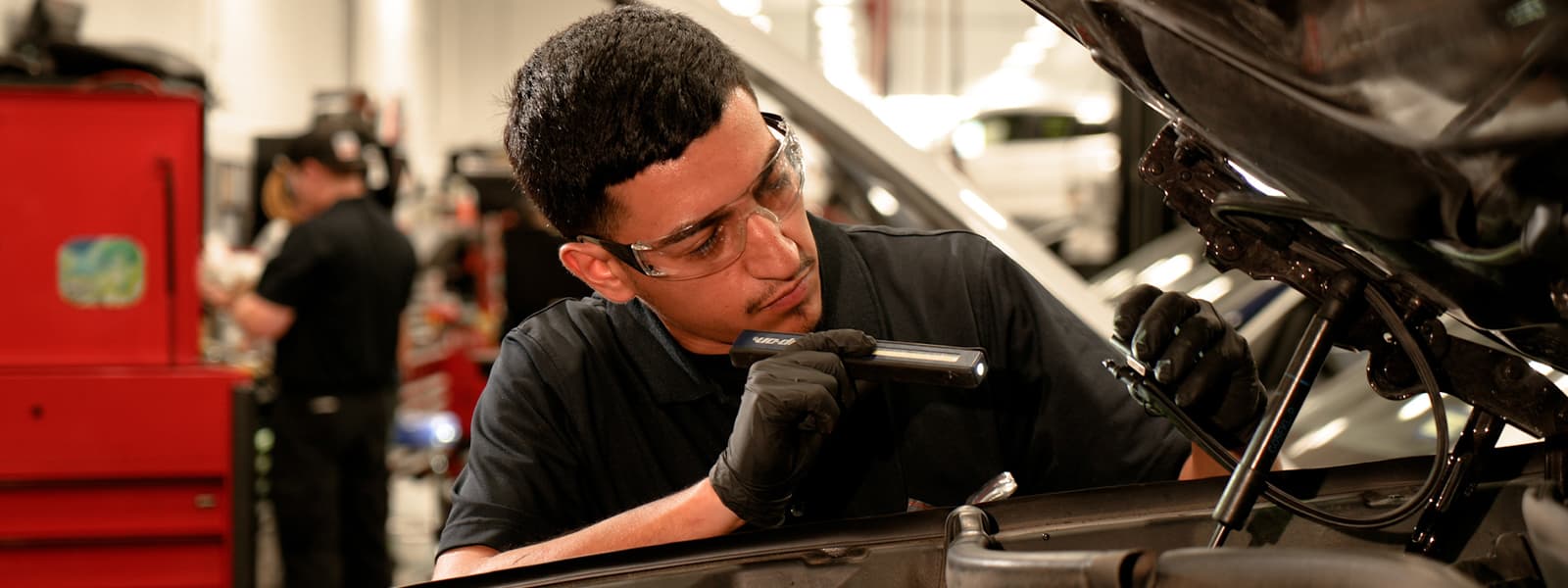
Inside an auto repair shop, every vehicle follows a clear path: Check-in, repair order, inspection and diagnosis, customer approval, service, quality checks and pickup.
Automotive technicians perform the hands-on technical work, while service advisors, parts employees, lead technicians and managers help coordinate communication, components and workflow.
Although exact procedures vary by employer, shop type and service need, these stages help repair facilities organize work and keep customers informed. Understanding the process can also help aspiring automotive technicians see how diagnostics, repair procedures, documentation, safety and teamwork come together in a professional service environment.
At Universal Technical Institute (UTI), Automotive & EV Technology students combine instructor-led online coursework with in-person lab training. This enables students to build familiarity with vehicle systems, tools, diagnostic processes and professional practices used in automotive service environments.1
What is an Auto Repair Shop?
An auto repair shop is a facility where automotive technicians inspect, maintain and repair vehicles. Some shops perform a broad range of services, while others specialize in particular brands, vehicle systems or types of repair.
Regardless of specialization, most repair facilities rely on the same basic elements:
- A written or digital record of the customer’s concern.
- A process for inspecting or diagnosing the vehicle.
- Customer authorization before additional work proceeds.
- Parts, tools and service information.
- Technicians who perform the work.
- Documentation and quality checks.
- Communication between the shop and the customer.
Read: How Vehicle Diagnostics Technology Is Changing Auto Repair
How a Vehicle Moves Through the Shop — Step by Step
A typical auto repair shop workflow moves a vehicle through five broad stages: Check-in and repair order creation, inspection or diagnosis, estimate authorization, service work, and final verification. The exact sequence can change based on whether the customer arrives for planned maintenance or because something has gone wrong.
Two Common Paths Through an Auto Repair Shop
Not every vehicle enters a repair shop for the same reason. Most visits follow one of two general paths.
A maintenance visit may move through:
Check-in → repair order → routine inspection or service → additional findings, if any → quality check → final delivery
A diagnosis-driven repair visit may move through:
Check-in → symptom verification → testing and diagnosis → estimate and authorization → repair → post-repair verification → final delivery
The two paths can overlap. A technician performing scheduled maintenance may discover another concern, while a diagnostic visit may reveal maintenance that is also due. When the scope changes, the shop may need additional customer authorization before moving forward.
Read: Automotive Technician Career Guide: Training, Skills, Certifications and Career Paths
Key Terms Used During the Repair Process
Several documents and decisions help organize the work:
- Repair order or work order: The shop record containing vehicle information, the customer’s concern, requested services and authorized work.
- Estimate: The anticipated scope, parts, labor and cost of recommended services.
- Authorization: The customer’s approval for the shop to complete specified work.
- Final invoice: The record of the services completed, parts used and charges due.
These terms are related, but not interchangeable. A repair order tracks the job, an estimate describes proposed work, authorization allows the work to proceed and the final invoice records what was completed.
Step 1: Customer check-in and repair order creation
The process often begins when a customer schedules service or brings a vehicle to the shop. A service advisor records the vehicle information, listens to the customer’s concerns and asks questions that may help clarify what the driver has noticed.
For a maintenance visit, the customer may request a specific service based on mileage, time elapsed or a maintenance schedule. For a repair visit, the concern may involve a warning light, unusual sound, performance problem, leak or other symptom.
The service advisor then creates a repair order. Depending on the shop, it may include:
- The customer’s description of the concern.
- Requested maintenance or inspection.
- Vehicle make, model, year and mileage.
- Relevant service history.
- Initial services the customer has authorized.
- Notes for the assigned technician.
A clear repair order gives the technician a starting point. Incomplete or vague information can make it harder to verify the concern and decide which diagnostic step should come first.
Read: Why Automotive Employers Like Cox Automotive Value UTI Training
Step 2: Inspection, maintenance or diagnosis
Once the vehicle enters the service area, the technician reviews the repair order and determines what the visit requires. A planned maintenance service may begin with a routine inspection, while a reported problem may require the technician to verify the symptom and develop a diagnostic approach. Inspection and diagnosis can involve:
- Reviewing warning lights or customer-reported symptoms.
- Performing a visual inspection.
- Checking fluid levels or visible components.
- Inspecting tires, brakes or suspension components.
- Connecting a diagnostic scan tool.
- Taking electrical or mechanical measurements.
- Consulting manufacturer service information.
- Comparing test results with specifications.
- Performing a road test when appropriate.
- Documenting findings and recommended next steps.
A diagnostic trouble code can identify the system or condition that leads to a fault, but it does not always identify the exact component that should be replaced. Technicians still need to test the related system, interpret the results and confirm the cause before recommending a repair.
Diagnosis is not simply guessing which part failed. It is a process of gathering evidence, narrowing down possible causes and deciding which test should come next.
Step 3: Estimate and repair authorization
After the technician documents the findings, the service advisor can explain the recommended work to the customer. The conversation may cover the condition found, proposed service, anticipated parts and labor, estimated cost, and expected timing.
Shops generally obtain customer authorization before completing work beyond what has already been approved, although specific requirements can vary by state, facility and repair situation. If the technician discovers another issue after work begins, the advisor may need to contact the customer again before the scope changes.
An estimate or authorization discussion may clarify:
- What work is being recommended.
- Why the work is being recommended.
- Which parts may be required.
- Estimated labor and cost.
- Whether diagnostic charges apply.
- What has already been authorized.
- Whether additional approval will be needed.
- When the shop expects to provide another update.
Technicians play an important role in this stage even when they do not speak directly with the customer. Their notes and test results give the service advisor the technical information needed to explain the recommendation accurately.
Read: Trade School vs. 4-Year College After High School: Which Path Makes Sense?
Step 4: Parts coordination and service work
After the customer authorizes the work, the technician can begin the approved maintenance or repair. Some services can move forward immediately, while others depend on parts availability, specialized equipment or access to an open service bay.
Technicians may work with parts employees to confirm component numbers, availability and delivery timing. They then use the repair order, service information, tools and shop procedures to complete the assigned work.
This stage can involve:
- Selecting the correct tools and equipment.
- Following service procedures.
- Using manufacturer specifications.
- Removing, inspecting or replacing components.
- Protecting surrounding parts and surfaces.
- Keeping removed components and hardware organized.
- Recording work performed.
- Updating the customer if the scope or timing changes.
If the technician encounters a condition that changes the recommended repair, the new finding should be documented and communicated through the shop’s established process before unapproved work proceeds.
Step 5: Quality checks, final documentation and delivery
Completing the physical service does not automatically complete the job. The technician or another shop employee may inspect the work, confirm fluid levels, check for leaks, clear diagnostic codes, retest a system or perform a road test when appropriate.
For a diagnosis-driven repair, the shop should verify whether the service addressed the original concern. For routine maintenance, the final review may focus on confirming that the required service steps were completed and the vehicle is ready for delivery.
The final review can include:
- Technician notes.
- Completed maintenance or repair procedures.
- Parts used or replaced.
- Diagnostic and test results.
- Quality control checks.
- The final invoice.
- Future service recommendations.
- Customer pickup instructions.
The service advisor may then explain the completed work, review the invoice and answer questions before returning the vehicle. Exact delivery procedures vary by facility.
Read: Automotive Mechanic Job Outlook 2026: Hiring Trends
What this process means for aspiring technicians
The repair process shows that automotive work involves more than fixing or physically removing and replacing parts. Technicians need to interpret customer concerns, follow diagnostic steps, use service information, document findings, communicate with other employees and verify completed work.
Automotive training can introduce students to these responsibilities in a guided environment. Employers may still use different repair-order systems, productivity standards, tools and communication processes, but the underlying habits can carry across many service settings.
The Roles Inside an Auto Repair Shop
Auto repair shops depend on several people to move vehicles through the service process. Automotive technicians perform the hands-on technical work, while service advisors, lead technicians, parts employees and managers help organize the information, components and timing around it.
Automotive technicians
Automotive technicians inspect, diagnose, maintain and repair vehicles using tools, testing equipment, service information and shop procedures. Their responsibilities vary by employer, experience level and the types of vehicles or systems they service.
A technician may:
- Review repair orders.
- Inspect vehicle systems.
- Verify customer-reported symptoms.
- Use scan tools or testing equipment.
- Perform maintenance and repair procedures.
- Document findings.
- Communicate additional concerns.
- Test systems after service.
- Record the completed work.
The technician's role is central to the service process, but technicians rarely work in isolation. Their work depends on accurate information, available parts and communication with the rest of the shop.
Read: How To Become a Master Technician in 7 Steps
Service advisors
Service advisors are often the primary communication link between customers and the service department. While technicians focus on the vehicle, advisors help organize the visit and move information between the customer and the shop floor.
Service advisors may:
- Greet customers and record their concerns.
- Create or update repair orders.
- Review requested services.
- Communicate technician findings.
- Prepare or explain estimates.
- Obtain authorization.
- Provide repair updates.
- Review completed work at pickup.
A technician may identify the technical issue, but the service advisor often communicates that information to the customer and confirms whether the shop has approval to proceed.
Lead technicians or shop foremen
Larger shops may have lead technicians or shop foremen who provide technical guidance, support complex diagnostics, answer technicians’ questions and help review completed work. Exact responsibilities vary by employer.
This role can be especially important for entry-level technicians, who may need guidance when a diagnostic path becomes more complicated or a repair requires procedures they have not performed before.
Read: Hybrid Car Repair: What Aspiring Technicians Need To Know
Parts teams and managers
Other shop employees help keep technicians supplied, scheduled and supported:
- Parts employees identify, order, receive and organize components needed for service work.
- Shop or service managers may oversee staffing, scheduling, safety, workflow and customer service.
- Administrative employees may maintain records, process payments or support communication with customers and vendors.
Together, these roles help move repair work forward without making the technician responsible for every operational task.
What an Automotive Technician Does During a Shop Day
A technician’s day is usually organized around assigned repair orders rather than one uninterrupted repair from opening to closing. A technician may move between maintenance work, inspections, diagnostic testing, repairs, parts delays and final quality checks.
Before starting a job, the technician may need to understand:
- What concern or service brought the vehicle in.
- Which work the customer has authorized.
- What inspection or diagnosis has already been completed.
- Which tools or service information may be needed.
- Whether the required parts are available.
- What findings still need to be documented.
Time management matters, but speed is not the only consideration. Technicians also need to follow procedures, avoid overlooking relevant details and communicate when the job changes.
For example:
- A technician may ask the service advisor to clarify a customer’s description.
- The parts department may confirm whether a component is available.
- A lead technician may help evaluate an unusual test result.
- The service advisor may contact the customer for additional authorization.
- The technician may pause one repair while waiting for parts and begin another assigned job.
The repair order helps keep this activity organized. It creates a record of the concern, findings, authorization, services performed and final results.
What technicians commonly track during the workday:
Workflow Area | What It Involves | Why It Matters |
Repair order review | Reading the concern, vehicle details and approved work | Provides a clear starting point |
Diagnostic planning | Choosing inspection and testing steps | Supports structured problem-solving |
Tool and equipment use | Selecting appropriate tools and service equipment | Helps work proceed accurately and safely |
Time management | Organizing multiple assigned tasks | Keeps work moving through the shop |
Advisor communication | Sharing findings, updates or additional concerns | Connects technical work with customer decisions |
Parts coordination | Identifying and obtaining needed components | Affects repair timing and completion |
Documentation | Recording findings, procedures and results | Supports accurate service records |
Quality checks | Confirming completed work and system operation | Helps verify the service addressed its purpose |
Read: Aaron Hernandez: From Childhood Curiosity to Career Confidence
How Dealership, Independent and Specialty Repair Shops Differ
Dealerships, independent repair shops and specialty service centers often share the same broad service process, but their vehicles, tools, staffing and daily workflow can differ.
Shop Environment | What the Work Can Involve | What Aspiring Technicians May Notice |
Dealership service department | Vehicles from a particular manufacturer, standardized procedures, brand-specific tools, and warranty or recall work | A more manufacturer-focused service environment |
Independent repair shop | Multiple makes and models, general maintenance, diagnostics and varied repair work | Broader exposure to different vehicles and systems |
Specialty repair center | Focused work involving transmissions, electrical systems, tires, collision repair, performance or another service category | More concentrated experience with a particular type of work |
Fleet service facility | Maintenance and repair for vehicles owned by a company, agency or transportation provider | A greater focus on preventive maintenance and keeping groups of vehicles operational |
Manufacturer-specific and multi-brand work
Dealership technicians often use procedures, diagnostic systems and tools associated with one manufacturer. Independent technicians may move between different makes, model years and system designs throughout the day.
One environment can offer deeper familiarity with a narrower vehicle group, while the other may require broader knowledge across brands. Neither is automatically the right fit for every technician.
How shop structure affects daily work
Large dealerships may use dedicated teams, dispatch systems and technicians who specialize in particular vehicle systems. Smaller independent shops may ask technicians to handle a wider mix of inspections, maintenance and repair work.
Specialty shops can narrow the work further by concentrating on a specific system or service. The same technician may encounter a very different pace, level of specialization and range of responsibilities depending on the employer.
Students do not need to choose a permanent work environment before beginning training. Understanding these differences can, however, help them identify the vehicles, systems and service settings they may want to explore.
What Automotive Technician Training Can Prepare Students for
Automotive technician training can introduce students to the technical skills and professional practices used throughout repair shop workflows. That includes not only working on vehicle systems, but also following safety procedures, using service information, documenting results and checking completed work.
Depending on the program and campus, students may have opportunities to practice skills related to:
- Shop safety and equipment use.
- Vehicle inspections.
- Scheduled maintenance.
- Diagnostic testing.
- Automotive electrical systems.
- Brake, steering and suspension systems.
- Engine performance.
- Service procedures
- Repair documentation
- Post-service checks
- Team communication
Training does not duplicate every employer’s exact workflow. Shops may use different software, tools, productivity systems and service procedures. Training can instead help students build a technical foundation and become familiar with the habits behind professional automotive work.
How shop tasks connect to automotive training
Repair-Shop Task | What Students May Practice | Connection to Shop Work |
Vehicle inspection | Checking systems, components and visible conditions | Builds information-gathering habits |
Diagnosis | Using tools, service information and testing procedures | Develops structured problem-solving skills |
Maintenance or repair | Following service steps on vehicle systems or components | Connects technical concepts with physical work |
Shop safety | Using tools, lifts, personal protective equipment (PPE) and equipment properly | Supports safer work practices |
Documentation | Recording procedures, findings and results | Connects technical work with communication |
Quality checks | Reviewing completed work and testing system operation | Reinforces accuracy and accountability |
Teamwork | Collaborating with instructors and other students during lab activities | Introduces the collaborative side of service work |
Tools and equipment students may use
Automotive training can give students opportunities to work with or around auto mechanic equipment and tools such as:
- Hand tools
- Torque tools
- Vehicle lifts
- Shop equipment
- Safety equipment and PPE
- Diagnostic scan tools
- Digital meters
- Battery and electrical testing equipment
- Automotive service information systems
- Fluids and service supplies
Students need to learn more than the name of each tool. They also need to understand when it is appropriate, how to use it safely, and how its results affect the next service or diagnostic step.
Vehicle systems covered in training
Depending on the campus and program curriculum, automotive technician training may cover areas such as:
- Driveability
- Braking systems
- Steering and suspension
- Electrical fundamentals
- Powertrains and transmissions
- Engine performance
- Automotive HVAC
- Preventative maintenance
- Hybrid or battery-electric vehicle concepts at select locations
Read: 8 Questions to Ask When Choosing an Automotive Mechanic School
What a typical automotive training day can include
A training day can combine instructor-led coursework, demonstrations, lab practice, tool use, diagnostic exercises and review of shop-style procedures. Exact schedules vary, but students should expect to move between learning a concept and applying it.
A hands-on training session may include:
- Reviewing an automotive system or service procedure.
- Watching an instructor demonstrate the task.
- Preparing tools and safety equipment.
- Practicing with components or training vehicles.
- Following service information.
- Recording findings or completed steps.
- Troubleshooting a problem.
- Reviewing the exercise with an instructor.
- Connecting the activity to work performed in repair shops.
Lab sessions may also involve cleaning the shop area, organizing tools and documenting the assignment. Those habits matter because professional technicians are evaluated on more than their ability to remove and replace a component.
How UTI connects training to shop-style work
UTI’s Automotive & EV Technology program combines instructor-led online coursework with in-person lab training. Students can build foundational knowledge of automotive systems and apply that knowledge through hands-on automotive practice involving tools, components, testing processes and training vehicles.
Course topics include drivability, undercar systems, powertrains and transmissions, braking systems, electrical fundamentals, automotive HVAC, and hybrid vehicle systems. Exact courses vary by campus.
Students should contact Admissions for current information about:
- Program availability
- Campus locations
- Course offerings
- Training schedules
- Lab formats
- Financial aid for those who qualify10
- Admissions requirements
- Application and enrollment steps
Hands-On Auto Training for Repair Shop Work FAQs18
How does an auto repair shop work?
An auto repair shop typically moves vehicles through check-in, repair order creation, inspection or diagnosis, estimate authorization, maintenance or repair work, quality checks, and final delivery. Technicians complete the technical work while service advisors, parts employees and managers help coordinate communication, components and workflow.
What happens when a vehicle first arrives at a repair shop?
A service advisor usually records the vehicle information, listens to the customer’s concern and creates a repair order. That record gives the technician information about the requested service, reported symptoms and work the customer has initially authorized.
What is a repair order?
A repair order, sometimes called a work order, is the written or digital record used to track a vehicle’s service visit. It can include the customer’s concern, vehicle information, inspection findings, authorized work, technician notes, parts and completed services.
What is the difference between a service advisor and an automotive technician?
An automotive technician inspects, diagnoses, maintains and repairs vehicles. A service advisor communicates with the customer, creates or updates repair orders, discusses estimates, obtains authorization, and explains completed work.
Does a diagnostic trouble code tell a technician which part to replace?
Not always. A diagnostic trouble code identifies a system or condition that reports a fault, but the technician may still need to inspect, test and interpret the related system before identifying the cause and recommending a repair.
Why does a repair shop need customer authorization?
Authorization confirms which work the customer has approved. Shops generally obtain approval before performing additional services, although specific authorization requirements can vary by state, facility and repair situation.
What happens after an automotive repair is completed?
The technician or another shop employee may inspect the work, retest the system, clear diagnostic codes or perform a road test when appropriate. The technician documents the results, and the service advisor may review the final invoice and completed work with the customer.
Do all auto repair shops follow the same process?
No. Most shops share broad stages such as check-in, inspection, authorization, service and final delivery, but exact procedures vary by employer, facility size, specialization and local requirements.
How can automotive training prepare students for a repair shop?
Automotive training can help students learn how to conduct and practice vehicle inspections, diagnostics, service procedures, tool use, shop safety, documentation and quality checks. Employers may still provide their own onboarding, equipment training and shop-specific processes.
Does UTI offer hands-on automotive technician training?
UTI offers Automotive & EV Technology training through a blended-learning format that combines instructor-led online coursework with in-person lab training. Program details, courses and availability vary by campus.
Explore Hands-On Automotive Technician Training at UTI
Auto repair shops rely on structured processes, technical skills, repair orders, communication and quality checks to move vehicles from check-in to final delivery. UTI’s Automotive & EV Technology program can help students build hands-on familiarity with vehicle systems, tools and diagnostic procedures used in automotive service environments.
If you’re interested in learning more about training opportunities and automotive careers, request more information. You can take the next step today by filling out an application.
Universal Technical Institute of Illinois, Inc. is approved by the Division of Private Business and Vocational Schools of the Illinois Board of Higher Education.
Train for the Future
Imagine waking up each day excited to work in a career you’re passionate about – one where your hands-on skills make a real impact. UTI’s vocational trade school can help you gain the skills and confidence to pursue what you love.
