
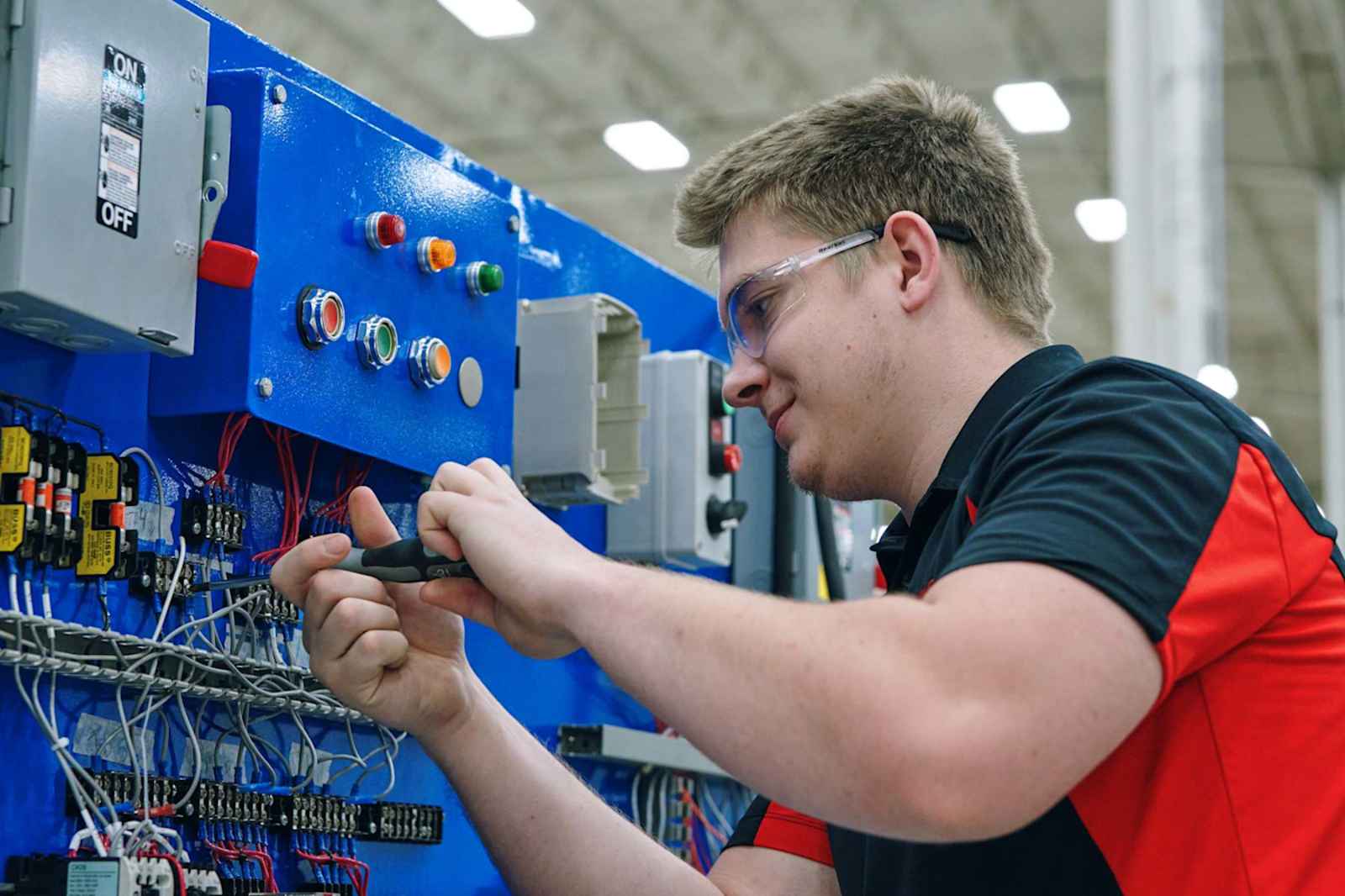
How To Enroll in Industrial Maintenance Technician Training
Getting started in our industrial maintenance training begins with three simple steps:
- Fill out the enrollment form.
- Talk with an Admissions Representative.
- Start industrial maintenance courses!
Our Admissions Representatives will work with you to help get any documents submitted and any additional information that’s needed. One qualification for our training includes proof of schooling, which could include:
- A standards-based high school diploma.
- A state-issued GED certificate or state-authorized equivalent exam.
- An official home-schooling certificate.
- A transcript or other evidence of having previously attended a Title IV-eligible program at a postsecondary institution.
For more information on admissions requirements, head here.23
Industrial Maintenance Course List
With hands-on labs and an instructor-led curriculum developed with industry experts, our students receive training to help prepare them to pursue a career.
Here’s a look at some of the industrial maintenance technician classes (courses may vary by campus):33
Introduction to Technical Trades
This course serves as an introduction to various trades that students will work with on a construction site. It focuses on helping them learn how to select, utilize and maintain tools for a specific task, and how to use them safely. Rigging operations, common hitches and various rigging equipment are covered, along with emergency hand stop signals. The course also covers guidelines for proper personal protection equipment (PPE).
Electrical Wiring
Students are focused on learning the National Electrical Code (NEC), AC current, AC circuits, load calculations, residential wiring, electrical lighting, electrical standards and AED, First Aid and CPR certification.
DC Electrical Theory
In this course, students will learn about direct current (DC) electrical theory and its applications. The course is designed to teach students how to interpret electrical circuit schematics and diagrams, including charging and storage functions. Students will design, calculate, build and troubleshoot various electrical circuits, using or constructing electrical schematics and employing proper testing equipment.
AC Electrical Theory
In this course, students will learn single-phase alternating current (AC) electrical theory and principles, as well as their applications to energy technology and power generation systems. Students will complete comprehensive lab projects, utilizing schematics to troubleshoot electrical faults and disassemble components for repair, testing and inspection.
Electrical Applications
Students learn about different types of conduits (EMT, PVC, IMT, RMC, FMC, etc.), wireways and raceways. Hand bending, machine bending conduit, saddle bends, offsets, heat bending PVC, fittings and conductor installations are also covered.
Computers and Networking
Students are taught how to identify and troubleshoot basic PC hardware and software components. Also covered is the use of computer applications in low-voltage industries as well as the installation and configuration of application software. Students will also learn how to install and configure specialized hardware components, along with how to network multiple computers together.
Programmable Logic Controllers
Students are building upon prior programming foundation to increase their knowledge to an industrial control level. Programming is explored in reference to industry specific control applications such as manufacturing and process control along with other practical applications.
Instrumentation and Control
Students are introduced to instrumentation and control theory, design, components and applications. They’ll learn processes involved with monitoring and controlling equipment. The course also will help teach students the utilization and testing of instrumentation and control components.
Industrial Robotics
This course introduces students to industrial robots, basic programming methods and the safety and maintenance involved with these robots. Students will learn about the benefits and needs of integration into robotics systems and demonstrate skills through lab projects and testing.
Mechanical Systems & Maintenance
Students continue to learn about electrical and mechanical relationships and connection used in the electrical mechanical engineering domain. This course has an emphasis on industrial and manufacturing applications. They will also demonstrate skills learned by connecting electrical mechanical systems and testing operation.
Career Paths for Industrial Maintenance Technicians
Our industrial maintenance training can be completed in just seven to 10 months.
There are several career avenues that could be pursued by skilled industrial maintenance technicians. Our grads start out prepared to work as entry-level technicians or in other entry-level roles.1 As with any industry, over time, they may be able to advance in their career with experience and hard work.77 Some entry-level and advanced industrial maintenance careers could include:
Entry-level
- Industrial maintenance technician
- Installation technician
- Field service technician
- Plant technician
Advanced
- Maintenance mechanic
- Major component mechanic