Robots are everywhere in modern manufacturing, performing tasks from assembling cars to sorting snacks.
But not all robots work the same. Each type has its own shape, speed and purpose.
If you're curious about robotics or thinking about pursuing a career in the field, learning about the different types of industrial robots is a great place to start.1 You can also get hands-on training to practice industry-aligned skills on real technology used in the industry today.
Below, we’ll break down the most common robot types used in industry — and how they’re helping shape today’s production lines.
Articulated Robots

Definition and features
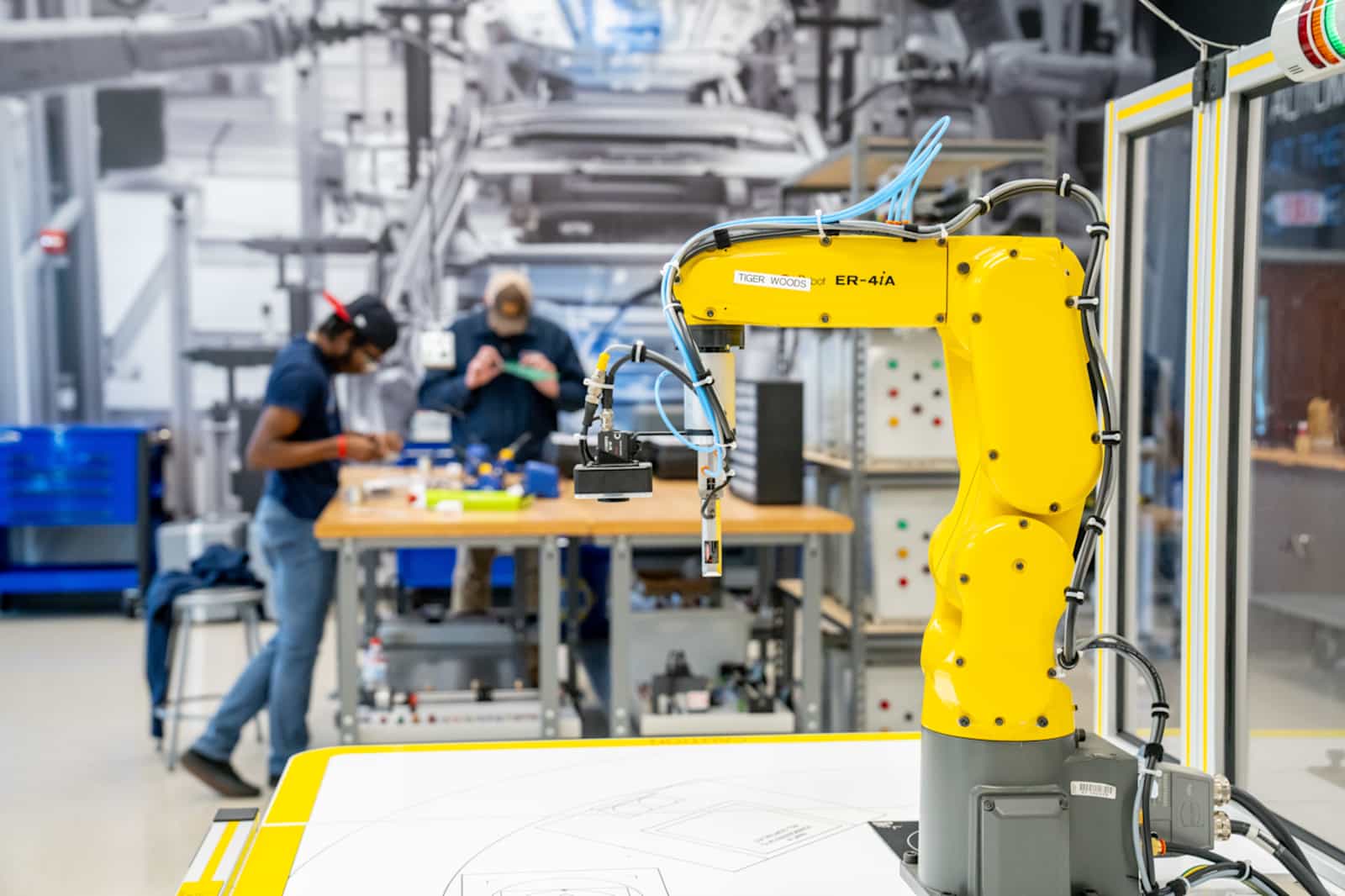
Articulated robots have arms that move like a human shoulder, elbow and wrist. They’re known for flexibility and range of motion. These robots often have four to six joints, which gives them the freedom to twist, turn and reach in many directions.
Uses in welding and assembly
Because of how much they can move, articulated robots are used for complex tasks like welding and putting parts together. They show up in factories where cars, appliances or heavy machines are built. You can often find them working nonstop, with high speed and repeatable accuracy.
Read: What Is Industrial Networking in Manufacturing?
SCARA Robots

Pick-and-place and packaging
SCARA stands for Selective Compliance Assembly Robot Arm. These robots work fast on a flat, horizontal plane. They’re mostly used to pick up items and place them in exact spots.
SCARA robots are common in electronics, food packaging and small assembly jobs. Their quick, repetitive motion makes them perfect for speeding up high-volume tasks.
Read: What Is a Programmable Logic Controller?
Cartesian (Gantry) Robots

Construction and precision
Cartesian robots move along three straight lines — X, Y and Z. Think of a 3D printer or a plotter. These robots are built with rails and tend to look like a box frame.
Because they move in straight paths, Cartesian robots are highly accurate. They’re also easy to program and often less expensive to maintain.
CNC applications and material handling
You can find Cartesian robots in industrial robot applications like CNC machinery, 3D printing and automated cutting. They’re also used to move heavy materials across short, defined distances.
Read: The 4 Main Types of Automation Explained
Delta Robots
Speed and lightweight design
Delta robots are spider-shaped and mounted above the workspace. Their arms connect at a central point, allowing lightning-fast movement with low weight.
Sorting and food packaging
Speed is the top reason delta robots are used in sorting and food processing. They’re ideal for picking up small items like baked goods or electronics, often working alongside conveyor belts.
Read: Application of Robotics: When, Where and How They’re Used
Collaborative (Cobots)
Safety features and human interaction
Cobots — or collaborative robots — are built to safely work next to people. They’re equipped with sensors and controls to avoid injuries. They move more slowly and pause automatically if they sense human contact.
Assembly, inspection and lab environments
Cobots are becoming more common in assembly lines, quality control and medical labs. They handle light, repetitive tasks that free up workers for more complex jobs.
Read: Troubleshooting Industrial Robots: Skills Technicians Need
Skills to Work on Different Types of Industrial Robots
Robotics & Automation training students can learn hands-on servicing skills to work on robotic systems used in today’s smart factories. While enrolled, students can train using equipment that reflects real-world manufacturing tech.
Whether it’s working with programmable logic controllers or wiring sensors and actuators, students get the chance to build strong technical skills through active learning.
Read: Your Guide to National Robotics & Automation Certifications
Builds Skills With Robotics & Automation Training
Trained workers who understand the role of robots in manufacturing help keep the future moving. If you’re interested in a career that blends advanced technology, problem-solving and hands-on skills, 12-18 month Robotics & Automation training at Universal Technical Institute can help you get there.1
Ready to take the first step? Enroll now, or get in touch with an Admissions Representative today by dialing 1-800-834-7308 or by requesting information online.
Universal Technical Institute of Illinois, Inc. is approved by the Division of Private Business and Vocational Schools of the Illinois Board of Higher Education.