
Collision
How to Become an Auto Body Shop Manager
Auto body shop managers help keep service departments and shops running smoothly. Learn more about the role here.
In This Article
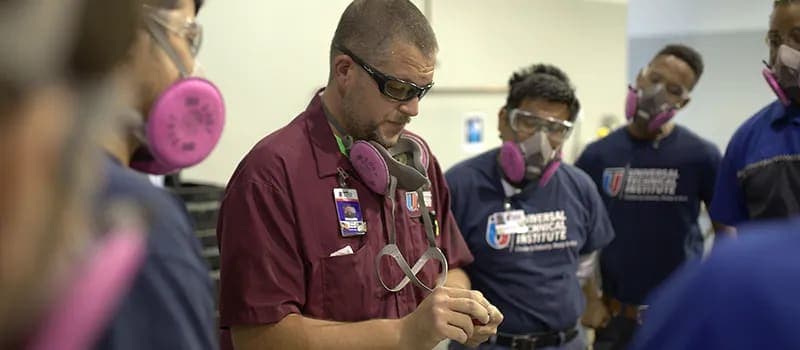
Restoring and reshaping vehicles is the main job of collision repair technicians. Also known as automotive body repair technicians, these professionals provide the crucial service of getting damaged vehicles back up and running.
A collision repair technician with experience in the industry might consider advancing to the role of auto body shop manager, where they can help ensure a dealership or shop is running smoothly.77
Body shop managers play an important part in running repair shops and providing support to the collision repair technicians who work there. Keep reading to find out how to build toward a role as a body shop manager, including learning skills in a collision repair program.
Auto Body Shop Manager Job Description
There are a lot of variables that come with working in an automotive repair or body shop. This means that the daily job duties of a body shop manager can vary as well.
Day-to-day responsibilities might include:
- Ensuring the department is running as efficiently as possible.
- Implementing marketing strategies to drive business.
- Checking the quality of completed repairs.
- Handling customer complaints or questions.
- Forecasting goals and objectives for the department.
- Handling accounting duties.
- Overseeing shop maintenance.
- Checking equipment for quality.
- Managing and coaching collision repair technicians.
- Documenting work performed in the shop.
- Training new employees.
- Interviewing potential employees.
A body shop manager must have strong communication skills, as well as the capability of leading a team and managing employees. They also should have attention to detail and a background in collision repair, so they’re able to thoroughly check completed repair jobs.
Auto Body Shop Manager Salary and Job Outlook
Those interested in a role as an auto body shop manager will likely start in an entry-level role, like a collision repair technician or estimator. This will help them to gain the knowledge and skills needed to be able to effectively manage a shop and other technicians.

The U.S. Bureau of Labor Statistics (BLS) is a great resource that can help you get an idea of what to expect when it comes to median salary in the field. While there is no specific data for body shop managers, the BLS does have information for automotive body and related repairers.
According to the BLS, the median annual salary for automotive body and related repairers in the United States was $54,890 in May 2025.28 This means half of collision repair technicians earned more and half earned less. Keep in mind that salary depends on several factors, including experience, employer, demand and cost of living in the area.
How to Become an Auto Body Shop Manager
Before pursuing a managerial role in any industry, it helps to have hands-on experience and an education that can be applied to the position. There are some steps you can take to prepare yourself to pursue a role in body shop management. These include:
Step 1: Complete high school or earn a GED certificate
A high school diploma or GED certificate is the first step toward pursuing a career in collision repair. It’s important to meet the basic education requirements that employers and training programs expect.
Step 2: Get collision repair training
Formal training can help you build the hands-on skills employers look for. Many students choose to attend a trade school like UTI, where they can learn how to assess vehicle damage, perform repairs and understand refinishing processes.1,20 Training gives aspiring technicians the chance to practice real-world procedures in a structured environment.
Step 3: Learn structural, nonstructural and estimating skills
Collision repair professionals need a blend of technical and analytical abilities. With programs like the CRRT program offered at UTI, students learn how to repair structural and nonstructural damage, restore vehicle integrity and prepare accurate cost estimates. These core skills are essential for anyone planning to advance in the field.
Step 4: Earn industry-recognized badges and credentials
Industry-recognized credentials can help candidates stand out when applying for jobs. UTI’s collision program was developed with I-CAR, a leader in collision repair training standards. Graduates can earn progress badges in areas like Non-Structural Technician, Steel Structural Technician, estimating and more!
Step 5: Gain experience and work toward management
After completing training, entry-level roles in collision repair allow new technicians to apply their skills and grow professionally. As they gain experience, they may begin taking on more responsibility. Over time, this progression could open the door to supervisory positions or, eventually, body shop management.
Body Shop Management FAQs
What does a body shop manager do?
A body shop manager oversees daily shop operations, including supervising technicians, managing repair estimates, coordinating workflow, maintaining quality standards and communicating with customers and insurance companies.
What experience is required to become a body shop manager?
Most managers have several years of hands-on collision repair experience. Knowledge of structural and nonstructural repairs, estimating, refinishing and basic leadership or customer service experience is often preferred.
How long does it take to train for a body shop manager career?
Many begin by completing a collision repair program, then spend a few years gaining experience as technicians. The timeline varies, but advancing to management typically takes a combination of formal training and industry experience.
What certifications are helpful for future body shop managers?
I-CAR progress badges in areas like Non-Structural Technician, Estimating and Refinish Technician can be valuable. ASE or manufacturer-specific collision certifications can also help boost a resume.
What skills are most important for body shop managers to have?
Body shop managers should have a variety of skills that include technical knowledge of collision repair, time management, problem-solving and leadership abilities.
Discover Collision Repair Training at UTI
If a career managing an auto body shop or repair department at a dealership sounds like it would be a good fit, you can take the first step and gain a foundational education in the Collision Repair & Refinish Technology program at UTI.1,20
In just 36 weeks, students can graduate ready for entry-level careers in the industry. Request more information about the program today, or if you’re ready to start, enroll now!
UTI Campuses That Offer Collision Repair Training
Source links:
Day-to-day responsibilities https://www.autojobs.com/jobs/auto-body-shop-manager-job-description/
BLS: https://www.bls.gov/
Median annual salary for automotive body and related repairers: https://www.bls.gov/oes/current/oes493021.htm
I-CAR: https://www.i-car.com/
Universal Technical Institute of Illinois, Inc. is approved by the Division of Private Business and Vocational Schools of the Illinois Board of Higher Education.

Train for the Future
Imagine waking up each day excited to work in a career you’re passionate about – one where your hands-on skills make a real impact. UTI’s vocational trade school can help you gain the skills and confidence to pursue what you love.
