
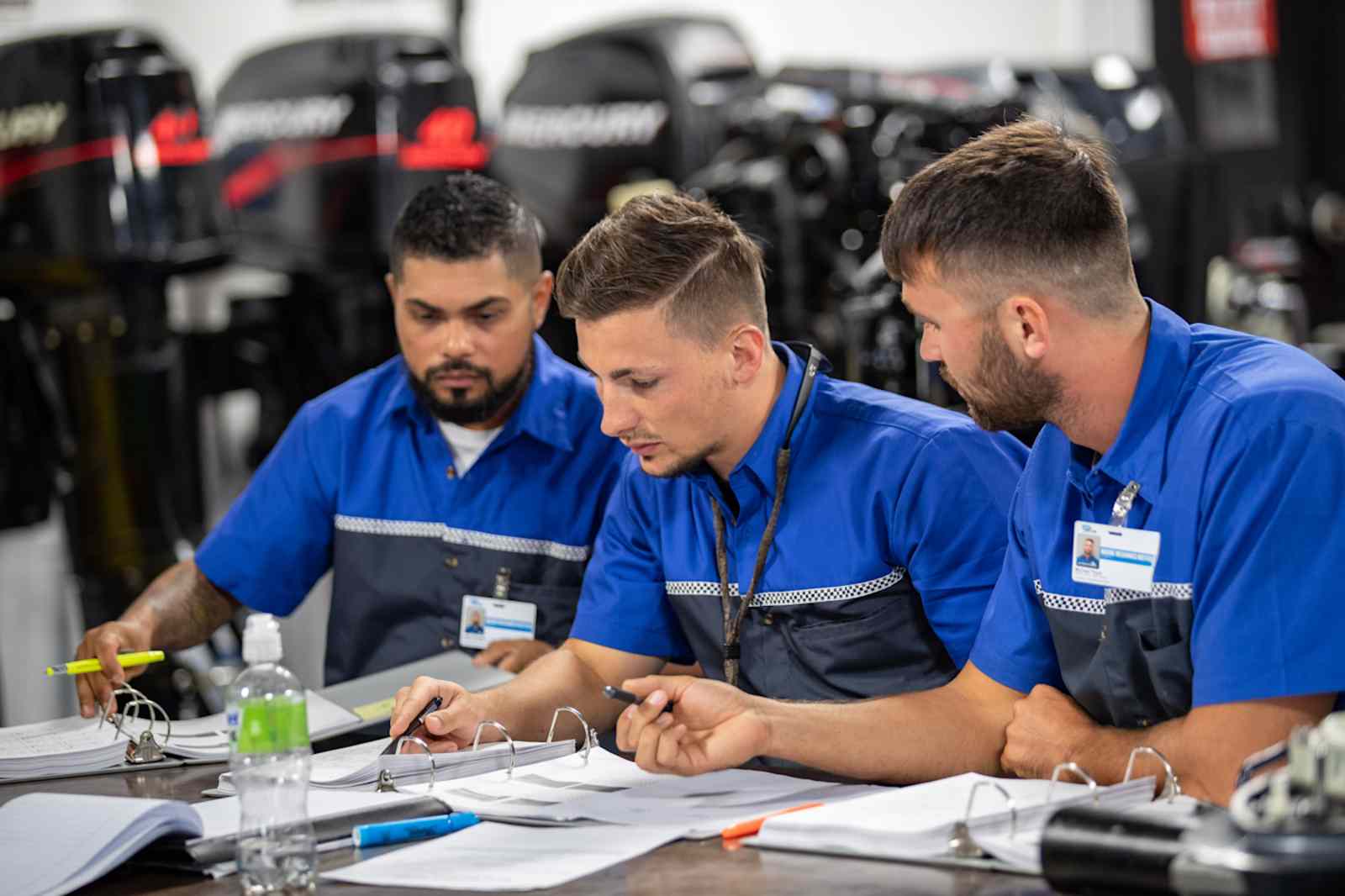
For many recent high school graduates, young adults and military service members, the idea of spending four years in college isn’t always the right fit. Fast trade school programs offer a different path — one focused on hands-on training, technical skills and quicker entry into the workforce.
Universal Technical Institute (UTI) offers some of the quickest trade school programs designed to help students build job-ready skills in less than a year.1,7 Instead of general education coursework, these programs prioritize career-specific training that aligns with real-world equipment and entry-level roles employers are hiring for today.
If you’re looking for fast trade school programs that can help you move from high school graduation to career-focused training in less than a year, here’s what to know.
What Are the Fastest Trade School Programs at UTI?
These UTI programs are structured to be completed in 12 months or less while still delivering focused, hands-on instruction.7,18
- Automotive Technology
- Diesel Technology
- Electrical, Electronics, & Industrial Technology
- Welding Technology
- Motorcycle Technician Training
- Marine Technician Specialist
- Collision Repair & Refinish Technology
- Industrial Maintenance Technology
- Wind Turbine Technician
- HVACR Technician
- Advanced Non-Destructive Testing Technician
- Robotics & Automation Technician Training
- Electrical, Robotics & Automation Technology
Each program is designed to concentrate on core technical skills tied directly to entry-level roles in the field.
Which UTI Trade Programs Can Be Completed in Less Than a Year?7
UTI offers a range of programs that qualify as the quickest trade school programs, giving students options across transportation, skilled trades, energy and industrial technology.
Below is an overview of UTI’s fast trade school programs and what students can expect from each.
Automotive Technology
Program length: 51 weeks.7
Locations: Offered at 14 UTI campuses nationwide. VA benefits may not be available at all locations.
What students learn: Automotive technology training focuses on diagnosing and repairing core vehicle systems, including engines, transmissions, brakes, electrical systems, HVAC, and hybrid and electric vehicle technology.
Entry-Level roles graduates may pursue: Automotive technician, quick service technician, service writer.
Learn more about Automotive Technology.
Diesel Technology
Program Length: 11 months.7
Locations: Offered at 13 UTI campuses. VA benefits may not be available at all locations.
What students learn: Diesel technology training focuses on servicing diesel engines, fuel and brake systems, powertrains, steering and suspension, electrical systems, hydraulics, transport refrigeration, and preventive maintenance.
Entry-Level roles graduates may pursue: Diesel technician, power generation technician, heavy equipment repair technician.
Explore Diesel Technology.
Electrical, Electronics, & Industrial Technology
Program length: 12 months.7
Locations: Offered at 8 UTI campuses. VA benefits may not be available at all locations.
What students learn: Electrical & electronics training focuses on electrical wiring and theory, electronics troubleshooting, computer and networking systems, security and fire alarm systems, industrial controls and robotics, and mechanical systems maintenance.
Entry-level roles graduates may pursue: Electrician’s assistant, mechatronics technician, electrical technician.130
UTI’s electrical programs do not prepare graduates for employment as electricians, and graduates will not be eligible for certification as an electrician without additional training and meeting state licensing requirements.
Learn about Electrical, Electronics, & Industrial Technology.
Welding Technology
Program Length: 9-10 months.
Locations: Offered at 15 UTI campuses. VA benefits may not be available at all locations.
What students learn: Welding technology training focuses on welding safety, fabrication and engineering fundamentals, and hands-on instruction across major welding processes including MIG, TIG, stick, flux-cored, and pipe welding applications.
Entry-level roles graduates may pursue: Welder, fabrication welder, welder fitter.
Explore Welding Technology.
Motorcycle Technician Training
Program Length: 11 months.7
Locations: Offered at 2 UTI campuses.
What students learn: Motorcycle technician training focuses on engines and transmissions, chassis and suspension systems, electrical fundamentals and diagnostics, routine maintenance, and troubleshooting engine performance and noise issues.
Entry-level roles graduates may pursue: Motorcycle technician, service writer.
Learn more about Motorcycle Technician Training.
Marine Technician Specialist
Program Length: 12 months.7
Locations: Offered at the UTI Orlando campus.
What Students Learn: Marine technology training focuses on marine engine systems, lower units and outdrives, fuel and lubrication, electrical fundamentals and diagnostics, diesel applications, manufacturer-specific technologies, rigging, and service operations.
Entry-Level Roles Graduates May Pursue: Marine technician, equipment maintenance technician.
Explore Marine Technician Specialist.
Collision Repair & Refinish Technology
Program Length: 9 months.
Locations: Offered at 2 UTI campuses. VA benefits may not be available at all locations.
What Students Learn: Collision repair training focuses on auto body repair and refinishing fundamentals, including surface preparation, paint systems and blending techniques, plastic and sheet metal repair, custom fabrication methods, and diagnosing and correcting finish defects to prepare vehicles for delivery.
Entry-Level Roles Graduates May Pursue: Collision repair technician, appraiser.
Learn about Collision Repair & Refinish Technology.
Industrial Maintenance
Program Length: 7–10 months, depending on the campus.
Locations: Offered at 10 UTI campuses. VA benefits may not be available at all locations.
What Students Learn: Industrial maintenance training focuses on safety and compliance, electrical fundamentals and theory, precision measurement, mechanical and materials processing, industrial heating and cooling systems, and servicing turbines, valves, and compressed systems.
Entry-Level Roles Graduates May Pursue: Industrial maintenance technician, field service technician.
Explore Industrial Maintenance Technology.
Wind Turbine Technician
Program Length: 7–8 months, depending on the campus.
Locations: Offered at 6 UTI campuses. VA benefits may not be available at all locations.
What Students Learn: Wind turbine technician training focuses on electrical wiring and troubleshooting, renewable energy systems, turbine components and controls, applied measurement skills, and wind turbine operations, safety, and climb-and-rescue procedures.
Entry-Level Roles Graduates May Pursue: Wind turbine technician, field service technician.
Learn more about Wind Turbine Technology.
HVACR Technician
Program Length: 9–10 months, depending on the campus.
Locations: Offered at 15 UTI campuses. VA benefits may not be available at all locations.
What Students Learn: HVACR technician training focuses on installing, maintaining and troubleshooting heating, ventilation, air conditioning and refrigeration systems, with emphasis on electrical diagnostics, safety practices, blueprint reading and preventive maintenance.
Entry-Level Roles Graduates May Pursue: HVACR technician, installation technician.
Learn about HVACR Technician.
Advanced Non-Destructive Testing Technician
Program Length: 9 months.
Locations: Offered at the UTI Houston campus.
What Students Learn: NDT training focuses on inspection and quality testing methods, including visual, magnetic particle, liquid penetrant, ultrasonic, radiographic, and eddy current testing techniques.
Entry-Level Roles Graduates May Pursue: Non-destructive testing technician, quality control technician.
Explore Advanced Non-Destructive Testing Technician.
Robotics & Automation Technician
Program Length: 12 months.
Locations: Offered at three UTI campuses.
What Students Learn: Robotics and automation technician training focuses on industrial robotics systems, automation controls, electrical fundamentals, and troubleshooting techniques used in automated manufacturing and production environments. Students learn how robotic systems operate and how to maintain, diagnose and support automated equipment.
Entry-Level Roles Graduates May Pursue: Robotics technician, automation technician, maintenance technician.
Explore Robotics & Automation Technician training.
Electrical, Robotics & Automation Technology
Program Length: 12 months.
Locations: Offered at eight UTI campuses. VA benefits may not be available at all locations.
What Students Learn: Electrical, Robotics & Automation Technology training focuses on electrical wiring and building systems, industrial robotics, CAD applications, and automation technologies used in construction and industrial environments. Students learn how to install, troubleshoot and maintain automated and electrically powered systems used across modern technical fields.
Entry-Level Roles Graduates May Pursue: Robotics technician, automation technician, electrical technician, maintenance technician.130
UTI’s electrical programs do not prepare graduates for employment as electricians, and graduates will not be eligible for certification as an electrician without additional training and meeting state licensing requirements.
Learn more about Electrical, Robotics & Automation Technology.
Why Faster Trade School Programs Can Lead to Quicker Job Readiness
Hands-on training vs. general education coursework
Fast trade school programs focus on practical skill development instead of broad academic requirements. Students spend more time training with tools, equipment and systems they would encounter on the job.
Skill-specific learning tied to real-world equipment
UTI’s programs are built around industry-relevant equipment and processes, helping students understand how their training applies in real work environments.
Industry-aligned curricula designed for entry-level roles
Curriculua are structured around the foundational skills employers look for in entry-level technicians, helping graduates transition more efficiently into the workforce.
The U.S. Bureau of Labor Statistics (BLS) reports that many installation, maintenance and repair occupations continue to generate job openings due to growth and worker replacement needs.
Start a Career-Focused Trade Program at UTI
If you’re ready to move quickly into hands-on career training, UTI’s fast trade school programs can help you build technical skills in 12 months or less, without committing to a four-year degree.
Whether you’re a recent high school graduate, a career changer or transitioning from military service, UTI offers focused programs designed to support your next step.
Apply now and start building your future.
Sources
https://www.bls.gov/ooh/installation-maintenance-and-repair/home.htm
Universal Technical Institute of Illinois, Inc. is approved by the Division of Private Business and Vocational Schools of the Illinois Board of Higher Education.