
Automotive
Wheel Alignment vs. Balancing: What’s the Difference? When Are They Used?
Find out what sets wheel alignment vs. balancing apart and when each service matters. Get details on how to get hands-on training for an auto mechanic career.
In This Article
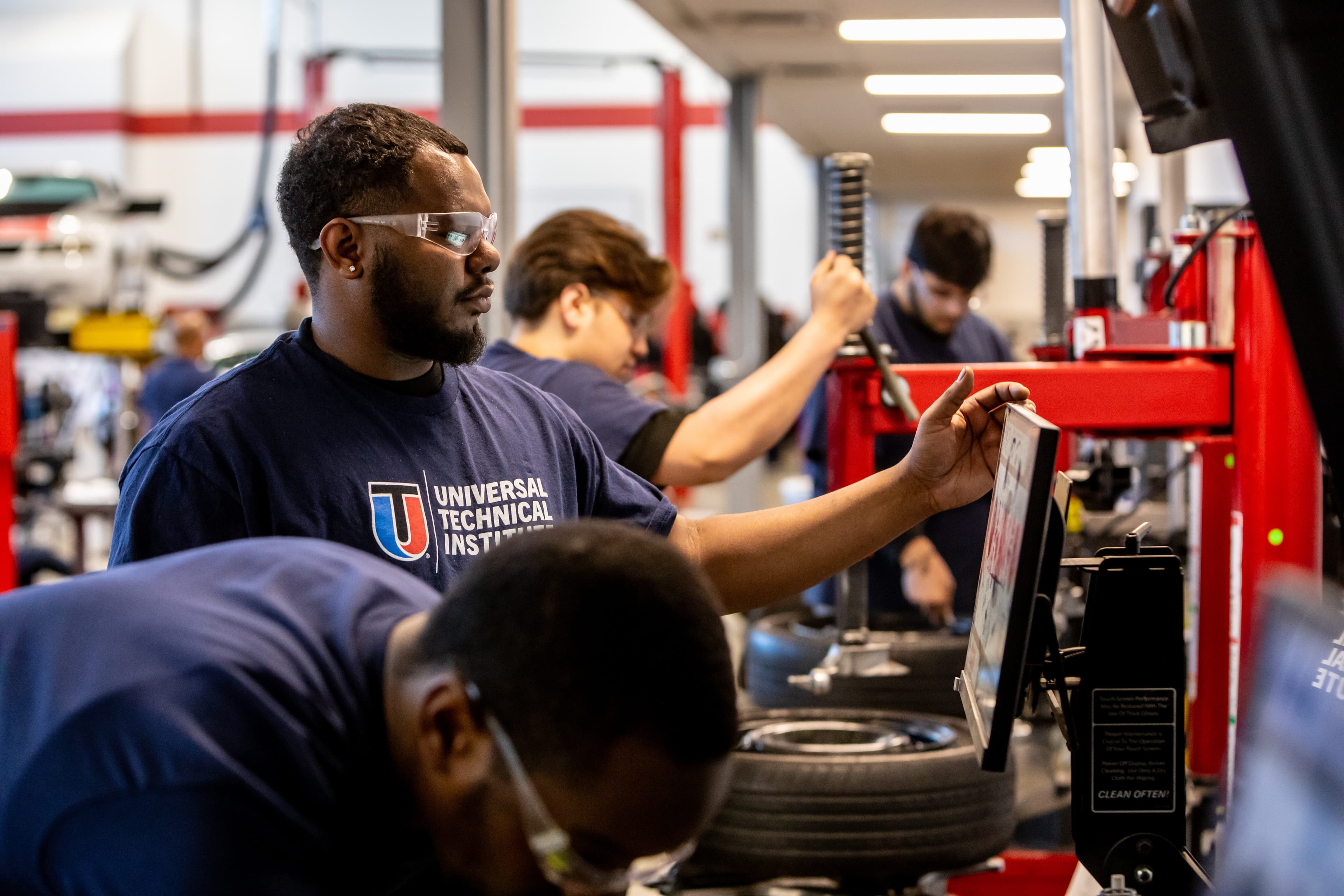
Your tires connect your vehicle to the road — yet many drivers don’t know the difference between wheel alignment vs. balancing.
Both services help cars ride smoothly and keep drivers safe, but they address very different problems. Confusing them can lead to wasted money or ongoing issues with handling.
Knowing the basics can save you time at the shop and help you spot early balancing or alignment symptoms before they damage your tires.
Keep reading to learn how each service works, what signs to watch for and how training in these skills can help prepare you for a career as an auto mechanic.
What Is a Wheel Alignment?

When a shop performs a wheel alignment, they adjust three angles that control how your wheels meet the road:
- Camber: The inward or outward tilt of the wheel when viewed from the front. Too much tilt causes uneven wear on the tire edges.
- Caster: The angle of the steering axis when viewed from the side. Proper caster helps keep steering stable and self-centering.
- Toe: The direction tires point compared to each other. If they angle in or out too far, it drags the tires and reduces fuel efficiency.
Together, these adjustments keep your steering precise and your tires lasting longer.
Symptoms of bad alignment
You can usually notice alignment problems in these ways:
- Pulling: If your car drifts left or right even on a straight road, alignment may be off.
- Off-center wheel: A crooked steering wheel while driving straight points to misaligned tires.
- Uneven tire wear: Bald spots or excessive wear on one side of a tire often mean angles are out of spec.
Catching these warning signs early can save you from bigger repairs later.
Read: How Do Supercharger and Turbocharger Engines Differ?
What Is Tire Balancing?

Tire balancing makes sure the weight is spread evenly across the wheel and tire assembly. Shops use machines to find heavy spots, then add tiny weights to even them out. The two types of imbalance are:
- Static: Balance on a single plane. Correcting this resolves up-and-down vibration in one spot.
- Dynamic: Balance across two planes. Fixing this addresses side-to-side wobble at higher speeds.
Balancing creates a smoother ride and protects suspension parts from excess stress.
Symptoms of imbalance
Imbalance shows itself differently than alignment issues. Symptoms include:
- Vibration at speed: The steering wheel or seats may shake once you reach highway speeds.
- Cupping: Tires develop scalloped dips that make noise and shorten their life.
- Shaky steering: Imbalance can cause steering to feel unstable or loose.
If your car shakes but doesn’t pull, it’s likely a balancing issue.
Read: CVT vs. Automatic Transmission: What’s the Difference?
Alignment vs. Balancing
Repair applications
Alignment:
- Corrects tire angles after hitting potholes or curbs.
- Restores proper handling after suspension work.
- Prevents uneven wear when installing lift or lowering kits.
Balancing:
- Smooths vibration after new tire installation.
- Reduces wear caused by heavy spots in wheels.
- Protects suspension by evening out wheel rotation.
Equipment used
Shops perform alignments with computer-guided alignment racks. These use sensors and lasers to measure each wheel angle to precise factory specs.
For balancing, technicians mount the wheel on a spin balancer. The machine detects heavy areas, then indicates where weights should be placed to correct them.
Length of service
An alignment often takes 30 minutes to an hour, depending on vehicle condition. Some jobs take longer if parts are damaged or seized.
Balancing is faster, usually 15–30 minutes for a set of four tires.
When you need just one
If your car pulls or if you see uneven wear, you likely need only an alignment.
If you feel shaking at speed but the car tracks straight, balancing is usually enough.
When you need both
Sometimes problems overlap. After installing new tires, both alignment and balancing are recommended. This ensures tires wear evenly and perform correctly from the start.
If you hit a large pothole, the wheel may shift out of alignment and lose balance at the same time. Getting both services saves time and prevents repeat visits.
Read: How Long Do Car Brakes Last?
When To Schedule Service
After new tires, suspension work, pothole hits or lift/lower kits
- New tires: Shops usually align and balance as part of installation.
- Suspension work: Anytime parts like tie rods or struts are replaced.
- Pothole hits: A deep pothole can knock angles and balance off.
- Lift or lowering kits: Change the geometry, so alignment is required.
Mileage and seasonal checks to extend tire life
Many shops recommend alignment every 6,000–12,000 miles. Checking after winter or rough seasonal driving also helps catch issues early.
Balancing should be checked whenever you rotate tires. Doing both at regular intervals extends tire life and improves fuel efficiency.
Read: What Types of Hands-On Training Do Auto Mechanics Need?
Costs, Time and What To Ask a Shop
Alignment usually costs more than balancing due to equipment and time. Balancing is often bundled with new tires.
Some shops offer warranty packages on alignments for a set number of miles. Always ask about coverage before paying for repeat visits.
Printouts, machine type and technician credentials
Modern alignment systems should provide a printout showing before-and-after angles. This transparency proves the work was done correctly.
Ask if the shop uses a digital or laser-guided machine. These offer more precision than older methods.
Read: What to Expect From Auto Mechanic School
Learning About Wheel Alignment and Tire Balancing

Automotive Technology students at Universal Technical Institute (UTI) spend less than a year learning how to diagnose, maintain and repair vehicles.7 Part of building this skillset involves learning how to solve wheel alignment and tire balancing problems using industry-aligned equipment.
Training includes practice on live vehicles in modern labs, not just simulations.18 No prior experience is needed — this program was designed to teach aspiring mechanics from the ground up.
On our campuses, instructors guide students through suspension and steering systems so graduates can identify root causes, not just symptoms. By training with current industry technologies, students can learn to provide accurate service trusted in real-world shops.
This hands-on approach builds confidence and hands-on skills that prepare graduates for entry-level roles as auto mechanics.1

Train To Learn Auto Skills Like Wheel Alignment and Tire Balancing!
Learning the difference between wheel alignment vs. balancing isn’t just useful for car owners — it’s essential for aspiring technicians. Training in these areas can be the first step toward a lasting career.
If you’re ready to start, Universal Technical Institute can help. Speak with an Admissions Representative by dialing 1-800-834-7308 or by clicking the button below.
Already know you’re ready to train? Enroll now.
Universal Technical Institute of Illinois, Inc. is approved by the Division of Private Business and Vocational Schools of the Illinois Board of Higher Education.
Train for the Future
Imagine waking up each day excited to work in a career you’re passionate about – one where your hands-on skills make a real impact. UTI’s vocational trade school can help you gain the skills and confidence to pursue what you love.
