
Why Choose UTI for HVACR Classes?
If you're considering a future in heating, ventilation, air conditioning and refrigeration, choosing the right training program is key. Universal Technical Institute (UTI) offers an HVACR Technician program designed to help you build real-world skills and prepare for entry-level opportunities in the field after graduation.1 Whether you're just starting out or making a career change, UTI’s HVACR courses provide the hands-on training and support you need to get started.
Here’s why students choose UTI for their HVACR tech training:
- Train in less than a year – Complete your HVACR training in 9-10 months, so you can start pursuing your career faster.
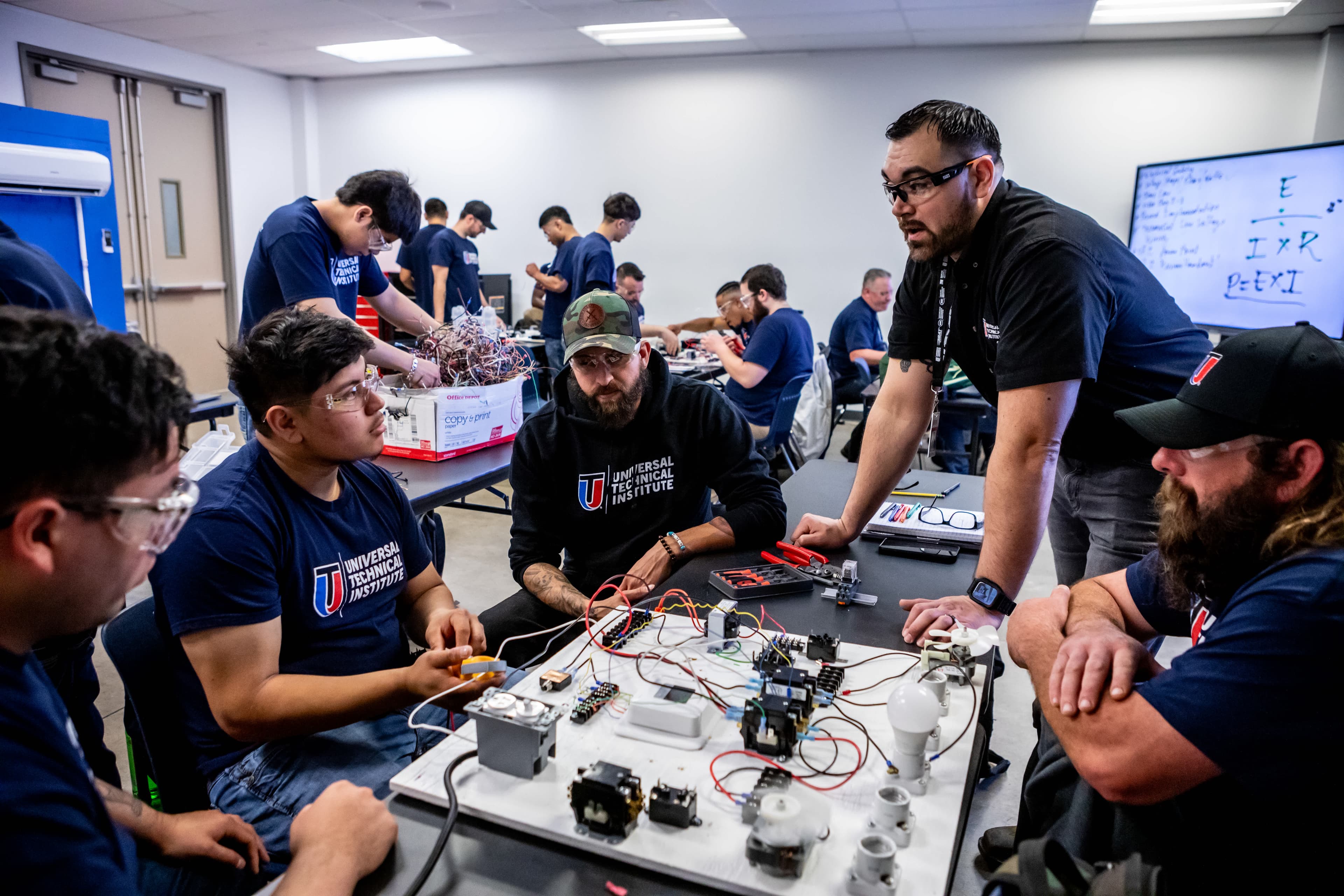
- Hands-on learning environment – Get real-world training using industry tools and equipment to help build your skills.
- Curriculum backed by the industry – Our HVACR courses are designed with input from manufacturers and employers, so you’re learning what matters.
- Career services support – From resume guidance to job search assistance, we offer career services to help you take the next step after graduation.
- No prior experience required – Our HVACR classes are built for beginners who are ready to train for skilled trades.
Ready to explore what you can learn in UTI’s HVACR program? Keep reading to discover our HVACR course offerings.
UTI’s HVACR Course Offerings
Explore the HVACR courses that help students build the skills needed to prepare for careers in the industry.³³
HVAC Core & Basic Electricity
Introduces students to HVACR career paths, professional associations and certification options. Focuses on electrical safety, theory and motors, including three-phase power supply, AC/DC voltage, circuit components, protection, schematics and the National Electric Code.
Key Takeaways:
- Learn electrical fundamentals and motor basics essential for HVACR technicians.
- Develop skills in reading and interpreting wiring diagrams and schematics.
- Gain core competency in troubleshooting residential and commercial electrical systems.
Electric Motors, OSHA
Focuses on Occupational Safety and Health Administration (OSHA) safety standards in HVACR work zones and hands-on training with electric motors. Covers motor operation, controls, diagnostics and repairs using pressure, electrical and temperature instruments.
Key Takeaways:
- Understand safety protocols and jobsite regulations.
- Diagnose and repair motor systems and control circuits.
- Utilize industry tools to troubleshoot motor-related failures professionally.
Basic Refrigeration Systems
Explores refrigeration system components, the refrigeration cycle, heat transfer methods and refrigerants. Also teaches proper handling, recovery and environmental impacts of refrigerants.
Key Takeaways:
- Understand system design and functional components of refrigeration units.
- Learn heat transfer principles and refrigerant types.
- Practice safe refrigerant recovery and recycling techniques.
Air Conditioning Systems I
Teaches installation and service techniques for residential and commercial air conditioning systems. Topics include piping, brazing/soldering, equipment sizing and refrigerant handling procedures (recovery, recycling, reclaiming).
Key Takeaways:
- Hands-on training in piping, brazing and system startup.
- Gain experience in sizing and selecting AC equipment.
- Understand proper refrigerant services and safety operations.
Heating Systems I
Covers hydronic heating systems such as hot water and steam boilers. Students learn system sizing, component identification, installation and maintenance procedures.
Key Takeaways:
- Identify components and select appropriate hydronic systems.
- Install and service residential hot water and steam boilers.
- Build foundational skills in heating system maintenance.
Indoor Air Fundamentals and Duct Fabrication
Explores air movement, humidity control, air quality and ventilation. Includes duct fabrication, assembly and service of air distribution systems to maintain indoor comfort and health.
Key Takeaways:
- Understand humidity, airflow, pollutants and climate impact on comfort.
- Learn duct fabrication tools and assembly techniques.
- Balance and service ventilation systems for optimal indoor air quality.
Heating Systems II
Advances into heat load calculations, equipment selection, installation and service for residential and commercial heating systems. Covers fossil fuel systems (gas, oil, electric) and control systems like thermostats and energy recovery units.
Key Takeaways:
- Perform heat load assessments and proper equipment sizing.
- Troubleshoot furnace and control issues using combustion analyzers and multi-meters.
- Install and maintain complete heating systems with integrated controls.
Air Conditioning Systems II
Emphasizes installation, maintenance and preventive service of advanced HVACR systems — including rooftop units and central AC systems. Continues focus on preventive maintenance techniques.
Key Takeaways:
- Probe advanced refrigerant systems, including commercial units.
- Perform preventative maintenance on residential and rooftop systems.
- Troubleshoot system performance using hands-on tools.
Construction Codes and EPA 608
Covers state and international mechanical codes that govern HVACR installations. Includes EPA 608 regulatory training — requirements for refrigerant recovery, leak detection and R-410A safety. Prepares for the EPA certification exam.
Key Takeaways:
- Gain knowledge of mechanical code compliance and regulatory standards.
- Learn EPA-approved refrigerant handling procedures.
- Be ready to take and pass the EPA Section 608 certification exam.
Alternative Heating Systems
Introduces non-traditional HVACR systems — including ductless multi-zone, geothermal systems, heat pumps, electric and oil heating systems. Covers installation and service considerations for these advanced technologies.
Key Takeaways:
- Explore installation and service of ductless and geothermal systems.
- Understand heat pump tech and alternative oil/electric heating setups.
- Develop knowledge of emerging HVACR technologies and system applications.
Nate Core & Building Management
Covers fundamentals of energy conservation, building controls and troubleshooting of control systems. Explores the role of IT in HVACR and building management system installation and service. Reviews NATE Core exam subjects, including safety, communication, math, science and electrical principles, to help students prepare for this industry-recognized certification.
Key Takeaways:
- Understand building controls, energy conservation and system optimization.
- Learn troubleshooting techniques for building management systems.
- Review core HVACR knowledge to prepare for the NATE Core exam.
Commercial Refrigeration I
Introduces students to commercial refrigeration systems and their applications. Covers system configurations, high- and low-side components, piping layouts and system operation. Includes discussion of specialized systems such as transportation refrigeration and alternative cooling methods.
Key Takeaways:
- Gain knowledge of commercial refrigeration system design and operation.
- Learn about high-side and low-side components and piping practices.
- Explore specialized applications like transportation refrigeration.
Commercial Refrigeration II
Builds on the concepts from Commercial Refrigeration I with advanced applications and troubleshooting. Provides additional hands-on training in system service, maintenance and performance analysis to reinforce technical skills.
Key Takeaways:
- Strengthen skills in advanced refrigeration system troubleshooting.
- Apply service and maintenance techniques to commercial systems.
- Deepen knowledge of refrigeration performance and system applications.