
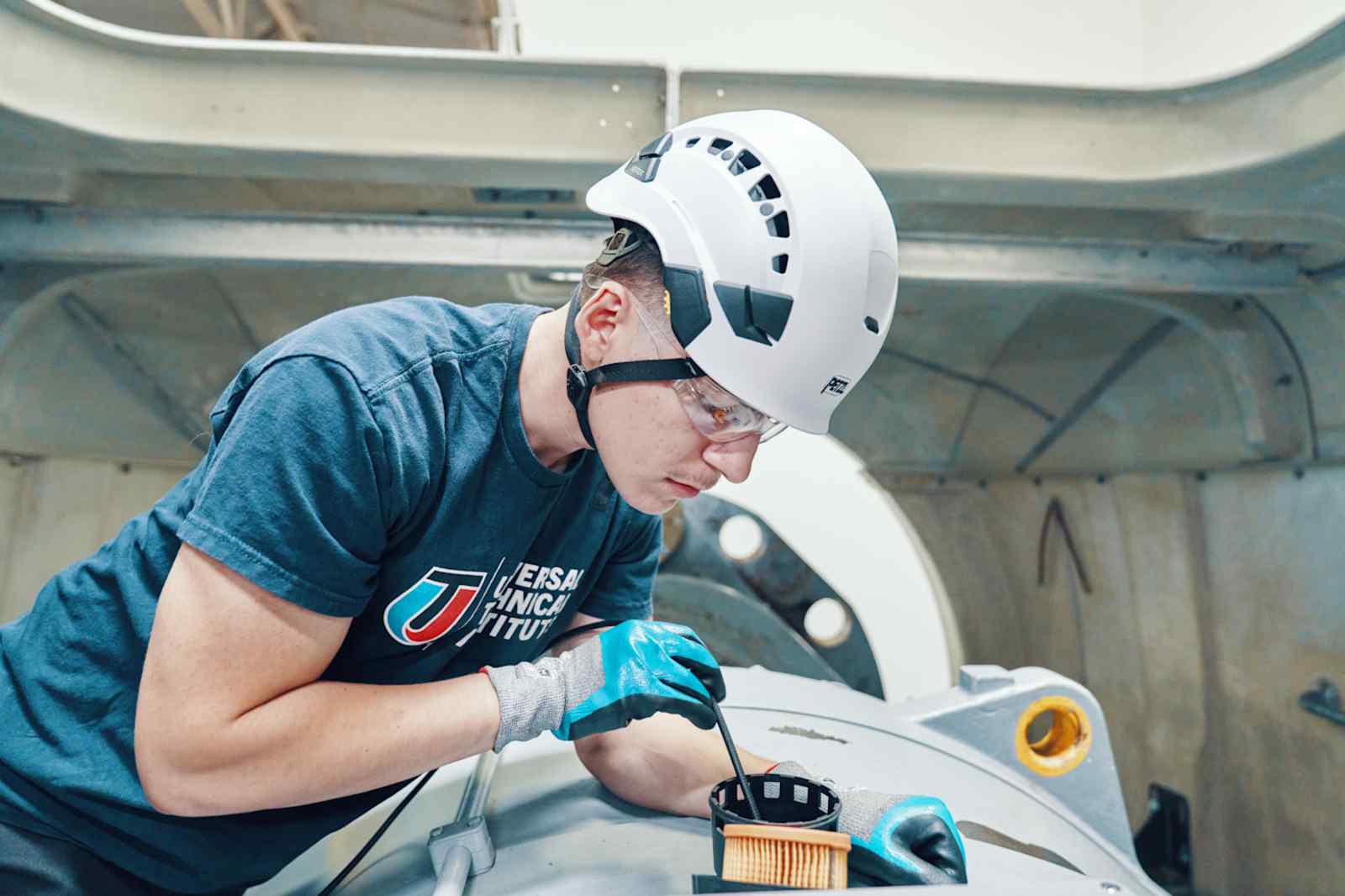
More emphasis is being placed on generating energy with cost-efficient, environmentally friendly sources. One of those renewable energy sources is wind, which is an industry in need of technicians to install turbines and keep them running. Universal Technical Institute’s wind turbine technician school helps prepare students to fill this need.1
Prerequisites for Enrolling in the Wind Turbine Technician Programs
There are some eligibility requirements for students applying to the Electrical & Wind Turbine Technology program or our other wind technician training.130 Applicants need to supply one of the following:
- Standards-based high school diploma
- State-issued GED certificate or diploma, or state-authorized equivalent exam
- Successful completion of a degree program at the post-secondary level or evidence of having previously attended a Title IV-eligible program
- Completion of an officially recognized home-schooling program
For more information, head here. Talk with an Admissions Representative for more information on all wind technician program requirements.
What You’ll Learn in Our Wind Turbine Training
Courses in UTI's Wind programs include relevant, real-world training with a curriculum developed hand-in-hand with employers.1 Some of the courses that students will take, along with their descriptions, are listed below:33
Introduction to Technical Trades
Students are introduced to a variety of skilled trades commonly found on construction sites, including carpentry, plumbing, ironworking, HVACR, drywall installation, masonry, welding and crane operations. The course provides an overview of how different trades work together to complete construction projects.
Students also learn about the safe selection, use and maintenance of common hand and power tools used across many construction crafts. Additional training focuses on workplace communication skills, including how to clearly understand verbal instructions and interpret written materials.
Applied Math and Measuring Tools
Instructors help students develop the foundational math skills commonly used in technical trades. Training covers calculations such as addition, subtraction, multiplication and division, along with working with fractions, measurements, volumes and basic geometric shapes used in construction and electrical work.
Electrical Wiring
Training introduces students to the National Electrical Code (NEC) and how its standards apply to safe electrical installations.
Students learn about alternating current (AC), AC circuits and basic load calculations while gaining exposure to residential wiring methods and electrical lighting systems. The course also reviews common electrical standards and safety practices. As part of this module, students complete training that includes AED, First Aid and CPR certification.
Electrical Applications
In this course, students learn about common electrical installation practices used in commercial and industrial environments. Training covers different types of conduits such as EMT, PVC, IMT, RMC and FMC, as well as wireways and raceways used to protect and route electrical conductors.
Students practice conduit installation techniques including hand bending, machine bending and heat bending PVC. Additional training focuses on creating saddle bends and offsets, installing fittings and properly routing and installing conductors within electrical systems.
DC Electrical Theory
In this course, students will learn direct current (DC) electrical theory and applications. This course is designed to teach students electrical circuit schematics and diagrams including charging and storage functions. Students:
- Design, calculate, build and troubleshoot.
- Learn about circuit operations and electrical fundamentals.
- Utilize proper testing equipment.
AC Electrical Theory
In this course, instructors teach students single-phase, alternating current, electrical theory and principles and their application to energy technology and power-generation systems. Students:
- Are taught AC electrical circuit schematics and design.
- Demonstrate complete lab projects with the use of schematics.
- Troubleshoot electrical faults.
Advanced Electrical and Controls
In this course, students will advance their knowledge of more sophisticated electrical circuits and troubleshooting electrical controls like Programmable Logic Controllers (PLC’s), relays, mechanical and solid-state devices, control devices and more.
Electrical and Electronics Troubleshooting
During this class in our wind turbine training, students learn the fundamentals of electrical and electronics troubleshooting used in modern electrical and mechanical systems. Students become familiar with common electrical test equipment and how it is used to diagnose issues in circuits and components.
Renewable Energy and Control Devices
In this course, students will learn about renewable energy systems. The course provides students with knowledge of renewable energy sources and how they function in the energy industry. Students:
- Demonstrate their acquired knowledge by conducting research projects.
- Practice hands-on application with renewable energy systems.
- Become familiar with the functions, operations, design, maintenance, troubleshooting and repair of these systems.
Wind Turbine Components
Instructors of this course teach about wind turbine power generation and its function in the renewable energy technology industry. Topics include the following:
- Fluid types
- System inspection
- Component identification, function, maintenance and repair
Wind Turbine Operations, Climb & Rescue / GWO - BST
In this part of their wind turbine training, students learn operations and design of wind turbines in the energy technology and power-generation industries. With the use of the correct equipment manuals and electrical schematics, students will properly disassemble, test and/or inspect and reassemble wind turbine components and systems crucial to systems operation. They will also be taught:
- Proper torquing procedures.
- Identification of and adherence to technical safety procedures.
- Hazards involved in working at heights.
- The American National Standards Institute (ANSI) and Global Wind Organization (GWO) basic safety training (BST) standards and safety regulations relating to safe and accurate climbing and rescue operations.
Wind Turbine Technician Career Opportunities After Graduation
Students in this program learn the skills they need to feel confident pursuing entry-level positions in the wind industry. Most of our grads start out prepared to work as entry-level technicians or in other entry-level roles. As with any industry, over time, they may be able to advance in their careers with experience and hard work. Some entry-level and advanced roles could include:77
Entry-level jobs
- Wind turbine technician
- Installation technician
- Field service technician
Advanced opportunities
- Troubleshooting technician
- LOTO I & II specialist
- Wind farm support specialist
- Electrical engineer
- Environmental engineer
- Materials engineer
For more information on wind turbine technician career paths and outlooks in the wind industry, head here.